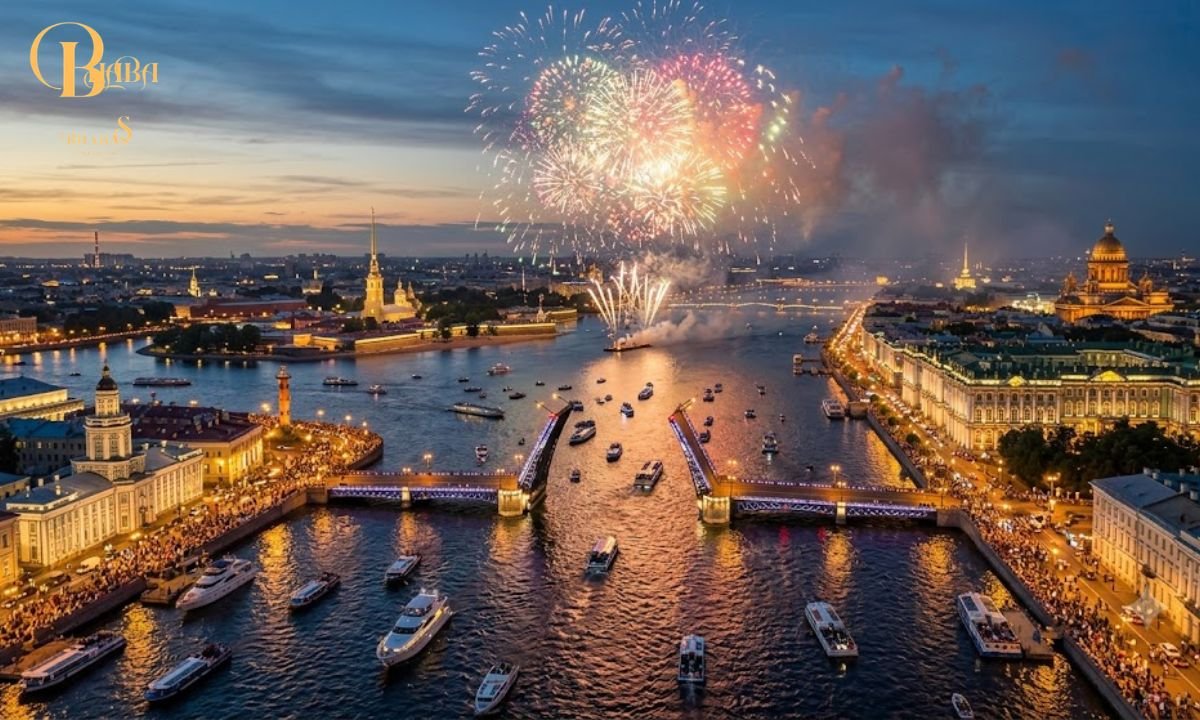
When the Sky Refuses
to Go Dark
The world’s most luminous cultural festival — where ballet, opera, and the midnight sun converge on the banks of the Neva.
~50
Nights of daylight
300+
Years of tradition
June–July
2026 season
5M+
Visitors per season
St Petersburg 2026
White Nights Festival in St Petersburg 2026 — What to Expect
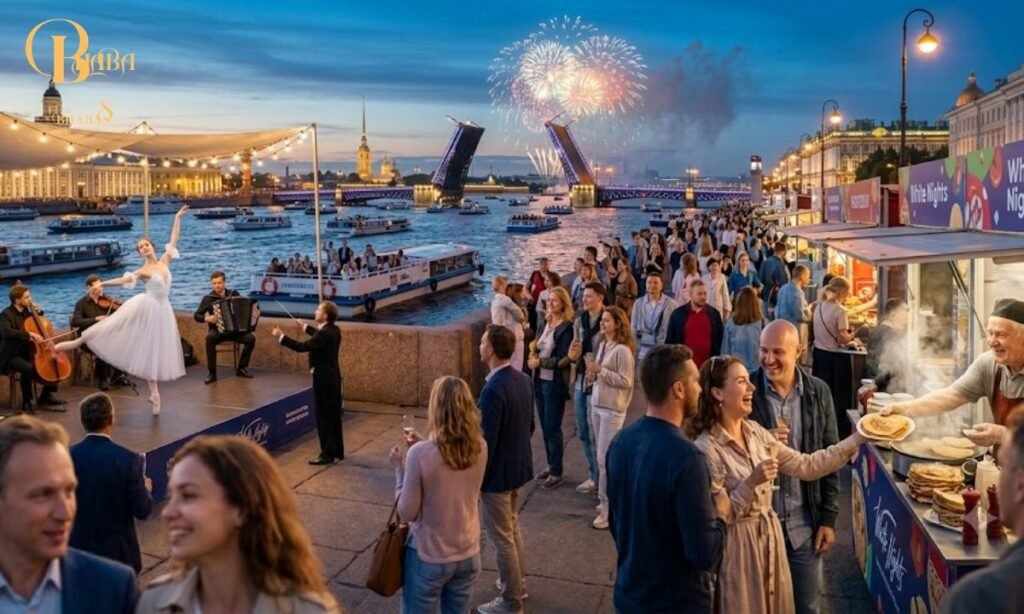
There are festivals. And then there is White Nights. The 2026 edition of St Petersburg’s legendary summer celebration arrives at a moment when the city’s appetite for cultural spectacle feels renewed, bold, and eager to remind the world of what it has always done best: produce moments of extraordinary beauty in extraordinary settings.
The festival in 2026 centres on the Mariinsky Theatre — the jewel of Russian performing arts — alongside the sprawling networks of palace gardens, canal embankments, and open-air stages that transform St Petersburg into a city you could walk through for days and never exhaust. At its core, the White Nights Festival is a classical arts festival: opera, ballet, and orchestral music performed at the highest level, by artists from Russia and across the world, against the backdrop of a city that does not sleep because, during these weeks, the sun simply refuses to.
“The strangest thing about St Petersburg in June is not the light — it is that the light makes everything feel possible. You walk out of a performance at midnight and the sky is amber and violet and completely, stubbornly awake.”
1703
St Petersburg Founded
1966
Mariinsky Festival Founded
21 Jun
Summer Solstice Peak
~19hrs
Daylight at Peak
The 2026 programme is expected to follow the structure that has made the festival internationally acclaimed: a Stars of the White Nights series anchored by the Mariinsky, bridge-opening ceremonies on the Neva, open-air classical concerts, and the spectacular Scarlet Sails celebration that draws hundreds of thousands of people to the riverbanks for one of the most theatrical events in world culture.
2026 Programme
White Nights Festival 2026 — Dates, Programme & Highlights
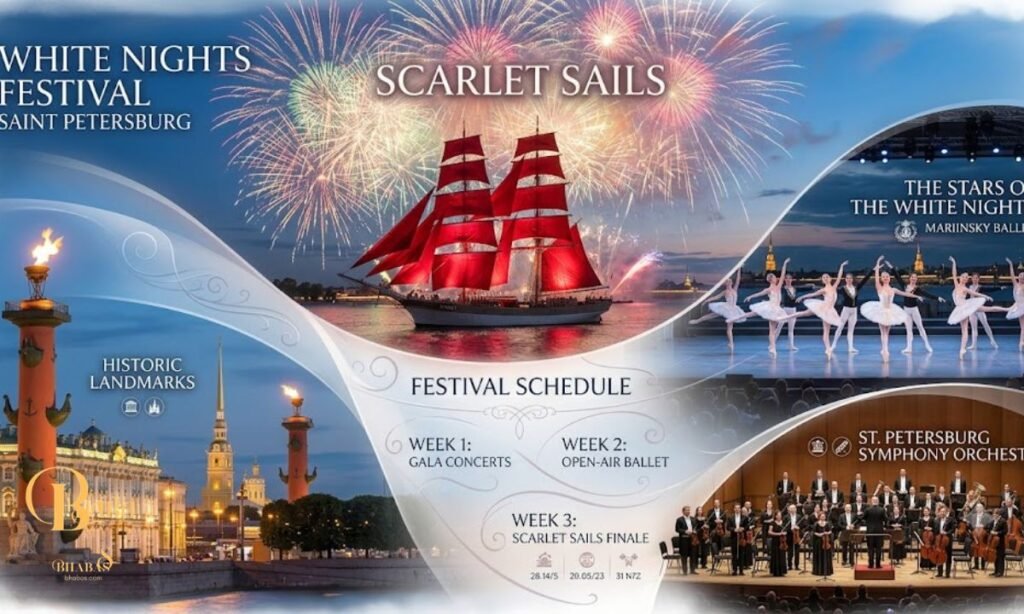
The White Nights Festival 2026 runs through the heart of the St Petersburg summer. The principal season extends from late May through mid-July 2026, with the most concentrated and celebrated programming clustered around the summer solstice in the third week of June — when daylight in the city peaks at close to 19 hours and the famous pale amber twilight fills the sky from around 11pm until 3am.
| Event / Series | Approximate Dates | Venue |
| Stars of the White Nights Flagship | Late May – mid-July 2026 | Mariinsky Theatre |
| Scarlet Sails (Алые Паруса) | Mid-June 2026 | Neva River |
| Palace Square Concerts | June 2026 | Hermitage / Palace Square |
| Early Music Festival | Early June 2026 | Capella Concert Hall |
| Open Air Film Screenings | June–July 2026 | Parks & Gardens |
| Bridges Drawbridge Ceremony Nightly | Late May – Sept 2026 | Neva Bridges |
The centrepiece of the 2026 festival is the Stars of the White Nights series, curated and conducted at the Mariinsky by Valery Gergiev — a programme that has, over decades, assembled the most significant names in classical performance into a single summer season. Expect landmark operas, principal ballet companies, and guest orchestras from across Europe and Asia performing in the theatre’s extraordinary acoustic spaces.
🌅
Scarlet Sails 2026: The most spectacular single night of the calendar. A full-rigged sailing ship with crimson sails crosses the Neva at midnight while fireworks illuminate the sky. Hundreds of thousands gather along the embankments. It is free to watch and completely unforgettable. Arrive by 10pm to secure a viewpoint.
Location
Where Is White Nights Festival Celebrated?
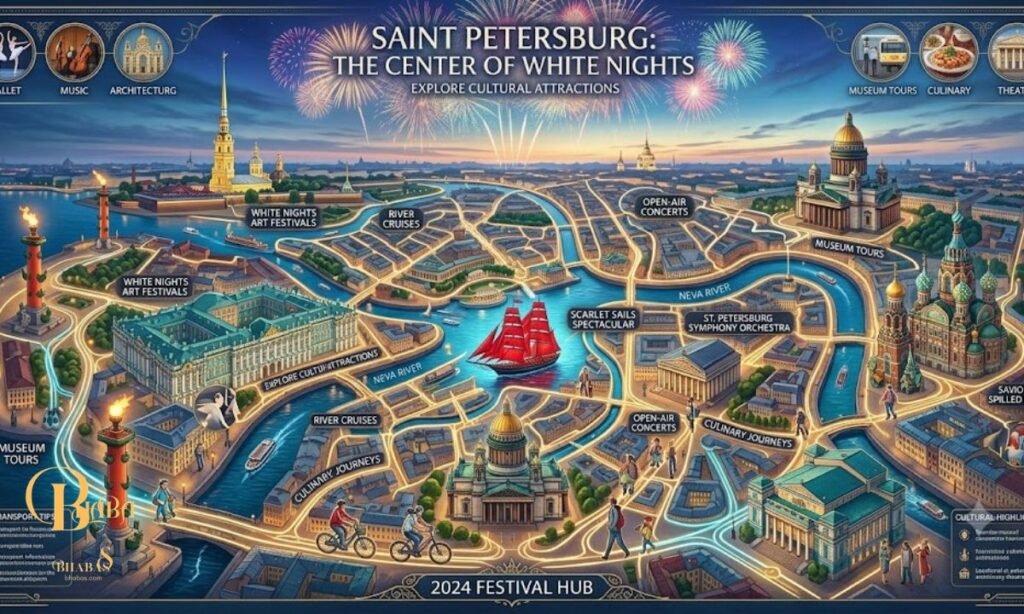
The White Nights Festival is celebrated in St Petersburg, Russia — a city built on 42 islands formed by the branches of the Neva River delta, at the latitude of 59.9° North. That latitude is the reason everything happens: St Petersburg sits further north than Oslo, Helsinki, and Stockholm, and at midsummer, the angle of the earth relative to the sun means the city never fully enters darkness. The sky shifts from pale blue to gold to lavender and back again, never quite dropping below the horizon.
The primary venues are concentrated in the historic centre of the city, a UNESCO World Heritage area that contains one of the densest collections of Baroque and Neoclassical architecture anywhere on earth. Within a single square kilometre, visitors can walk from the Winter Palace (home of the Hermitage Museum) to the Mariinsky Theatre, past the gilded dome of St Isaac’s Cathedral, along canals lined with imperial palaces, and across bridges with cast-iron railings that have stood since the reign of Catherine the Great.
🎭
Mariinsky Theatre
The historic and new stage — home of the Stars of the White Nights opera and ballet programme.
🏛️
Palace Square
Flanked by the Hermitage, this immense baroque plaza hosts open-air concerts and ceremonial events.
🌉
Neva Embankments
The river itself becomes a stage — for Scarlet Sails, bridge ceremonies and midnight promenading.
🎻
Capella Hall
Russia’s oldest concert hall, perfect for Early Music programming in an intimate neoclassical setting.
🏰
Peterhof Gardens
The “Russian Versailles” — spectacular outdoor concerts amid gilded fountains and baroque palace grounds.
🌳
Summer Garden
Peter the Great’s original garden park, redesigned and restored, offers ambient evening performances.
While the Mariinsky anchors the cultural programme, the festival’s real stage is the city itself. St Petersburg during the White Nights is not a festival you attend — it is an environment you inhabit. The light changes what everything looks like. Palace facades that seem imposing in winter become warm and theatrically lit by a sun that refuses to set. Locals and visitors alike move through the city with the unhurried freedom of people who know there is no rush, because the day will not end.
The City
White Nights Festival St Petersburg — The City That Makes It Possible
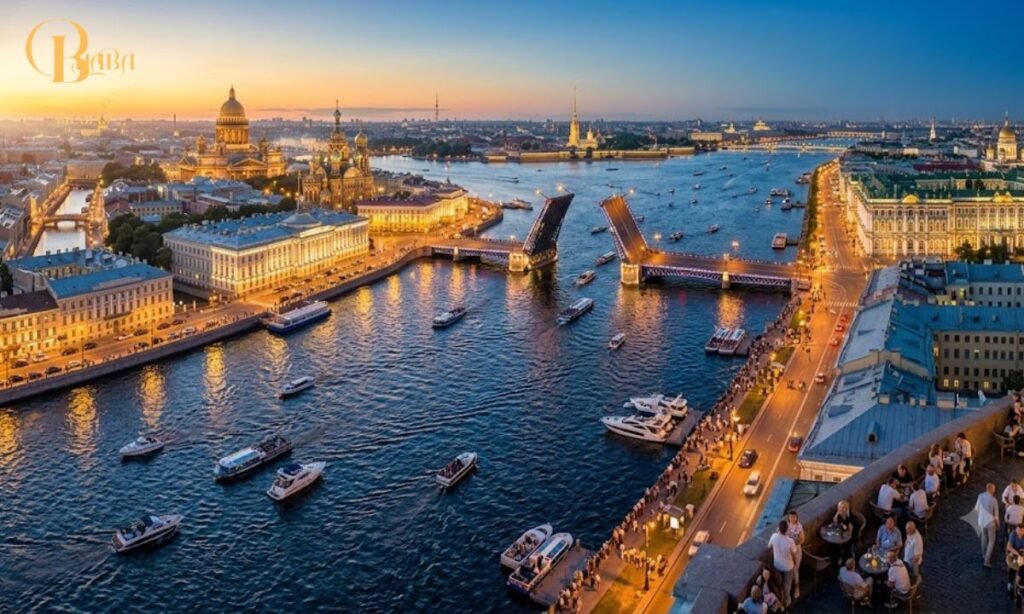
No other city on earth could host this festival in the same way. The White Nights phenomenon is not a concept or a marketing invention — it is a geological and astronomical fact that St Petersburg was built directly upon. Peter the Great chose this location in 1703, fully aware of its northern position, its access to the Baltic, and its capacity to become a window from Russia to Europe. He could not have known he was also choosing a canvas for one of the world’s most enduring natural light shows.
St Petersburg was designed from the beginning as a city of spectacle. Its founding architect, Domenico Trezzini, and the succession of court architects who followed — Bartolomeo Rastrelli, Giacomo Quarenghi, Carlo Rossi — built a city of extraordinary visual coherence: broad avenues ending in golden spires, palaces mirrored in still canals, bridges so elegant they became objects of civic pride in themselves. When the White Nights bathe all of this in a light that resembles neither day nor night but something entirely itself, the city fulfils its original ambition.
🏛 Hermitage Museum🎭 Mariinsky Theatre⛪ Church on Spilled Blood🏰 Peter & Paul Fortress💛 St Isaac’s Cathedral🌿 Peterhof Palace🌉 Neva Bridges📚 Russian Museum
“St Petersburg is a city that looks like it was built for one specific evening per year — and the White Nights is that evening, extended across six weeks.”
The Mariinsky Theatre, home to one of the world’s finest opera and ballet companies, sits at the heart of the Teatralnaya Ploshchad (Theatre Square). Its history runs in parallel with the city’s: founded as an imperial theatre in 1860, it survived revolution, siege, and the twentieth century with its standards ferociously intact. Under Valery Gergiev, who became artistic director in 1988, it became the festival’s engine — programming seasons of international scope and ambition that turned St Petersburg’s White Nights into an annual pilgrimage for classical arts lovers from across the world.
Russia
White Nights Festival in Russia — A Phenomenon Beyond One City
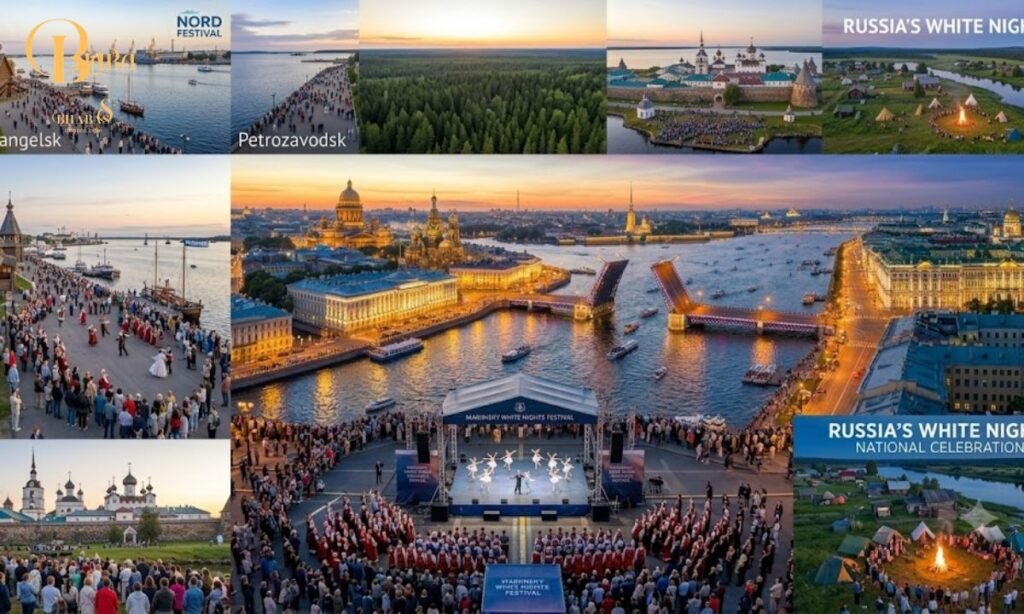
The White Nights belong to St Petersburg the way Carnival belongs to Venice — inextricably, definitively, as if the two were invented for each other. But the phenomenon of the white night extends across a wide arc of northern Russia, and it is worth understanding the full context of why Russia, and specifically this corner of it, became the home of the world’s most celebrated midsummer festival.
Russia’s northern regions — stretching from Karelia through the Kola Peninsula and into Siberia — experience extreme midsummer light at even higher latitudes. In Murmansk, above the Arctic Circle, the sun does not set at all for over a month. In St Petersburg, the effect is more subtle and arguably more affecting: the sky never goes black, but it shifts through colours that do not have precise names. Russians call the period belye nochi — white nights — and it carries a weight of cultural meaning that goes far beyond a calendar fact.
Dostoevsky wrote about the white nights in one of his earliest works. Pushkin described the extraordinary mood they induced — a dreamlike suspension of ordinary time. Tchaikovsky composed music in St Petersburg during these weeks. The white nights are embedded in Russian culture as a symbol of the uncanny, the suspended moment, the threshold between sleeping and waking. The festival that grew up around them is therefore not simply a programming decision — it is a response to something real in the Russian imagination.
Cultural note: The Russian phrase belye nochi (белые ночи) carries literary and philosophical weight dating back to the 18th century. When attending the festival, you are stepping into a cultural phenomenon that predates the modern programme by centuries.
History
The History Behind the Festival — From Tsars to Today
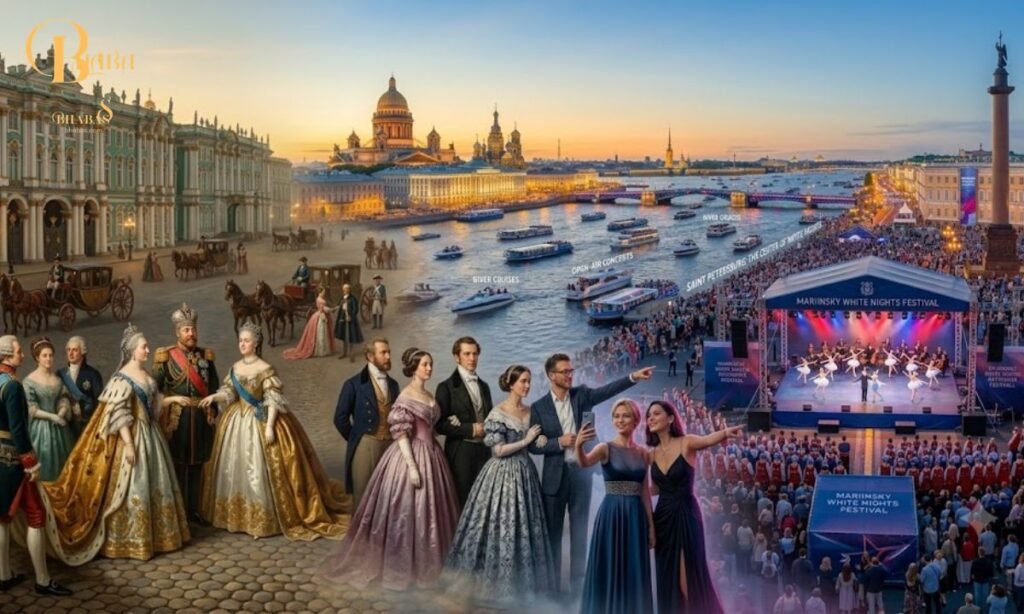
The White Nights as a cultural phenomenon have been celebrated in St Petersburg for as long as the city has existed. But the structured arts festival that the world now knows took shape over several distinct periods — each marked by a different relationship between art, power, and this extraordinary natural phenomenon.
Foundation of St Petersburg. Peter the Great establishes his new capital at 59.9° North, consciously building a European-style city where the midsummer light would be unlike anything in western Europe.
Mariinsky Theatre opens. The imperial court’s new opera and ballet house becomes the finest in Russia, cementing St Petersburg’s position as a world centre for classical performance.
Survival through revolution. The Mariinsky is nationalised but survives, renamed the Kirov. Throughout the Soviet era, its standards are maintained under state patronage — producing generations of the world’s finest dancers and singers.
Stars of the White Nights series begins. The Mariinsky formalises its summer programming into a festival structure, attracting international attention for the first time.
Valery Gergiev takes artistic control. The conductor transforms the Mariinsky into a global institution, expanding the festival programme dramatically and inviting the world’s leading performers to the St Petersburg stage.
Tricentennial celebrations. St Petersburg’s 300th anniversary brings the largest White Nights festival in history, with world leaders in attendance and performances across the entire city.
Today. The festival continues as one of the world’s premier classical arts events — a living tradition that links the imperial court, the Soviet era, and the present in a single unbroken thread of extraordinary performance.
What to See
What to See & Do During White Nights Festival 2026
The White Nights Festival is structured enough to plan around and loose enough to discover spontaneously. The Mariinsky’s ticketed programme forms the spine of any serious visit; everything else — the bridges, the embankments, the parks at midnight — is the body of the experience.
🩰
Ballet at the Mariinsky
The Kirov/Mariinsky Ballet is among the most technically accomplished companies in the world. Sleeping Beauty and Swan Lake performed here are definitive experiences.
🎼
Opera Evenings
Mussorgsky, Tchaikovsky and Prokofiev in their home city, performed in the theatre where many of these works had their world premieres.
⛵
Scarlet Sails Night
A brig with deep red sails crosses the Neva at midnight while fireworks explode overhead. The single most spectacular free event in Russian culture.
🌉
Bridge Opening Ceremony
At 1:25am nightly, the Neva’s famous bridges draw open simultaneously to let river traffic through. Thousands gather on embankments to watch.
🎸
Palace Square Concert
The enormous square in front of the Winter Palace hosts free and ticketed open-air concerts — a setting that makes any performance feel historically enormous.
🚣
Canal Boat at Midnight
Hire a small boat and drift through St Petersburg’s canal network at midnight. The reflections of palace facades in the still water under amber sky are something photography cannot quite capture.
Beyond the programmed events, the most unforgettable White Nights experiences are often the unscheduled ones. Walking along the Griboedov Canal at 2am when the light is still gold. Finding a courtyard concert by students from the Conservatory. Watching the drawbridges from a café table with the window open. The city performs even when nothing is scheduled, because the light will not allow it to go quiet.
Getting There
How to Get to St Petersburg for White Nights 2026
St Petersburg is served by Pulkovo International Airport (LED), which handles both domestic Russian flights and international connections. For travellers from Europe, the most practical routes depend significantly on current bilateral travel arrangements — visa requirements and direct flight availability should be checked carefully against up-to-date official sources, as these have been subject to change since 2022.
Within Russia, train connections from Moscow are frequent and efficient. The Sapsan high-speed train covers the Moscow–St Petersburg route (650km) in approximately 4 hours, with multiple daily departures from Moscow’s Moskovsky station. Travelling by overnight train is also an option, arriving refreshed for a full day in the city.
Visa note for 2026: International visitors should verify current Russian visa requirements well in advance of travel. Requirements, processing times, and entry arrangements have changed substantially in recent years. Consult your country’s foreign affairs or foreign ministry website for the most current guidance before booking.
Once in St Petersburg, the city is exceptionally walkable in the historic centre — most major festival venues lie within a 3–4km arc that can be covered comfortably on foot. The metro is clean, reliable, and affordable, though stations close from around 12:30am to 5:30am — a consideration during the White Nights when you may well be walking home at 3am in full daylight.
Insider Tips
Insider Tips for First-Time White Nights Visitors
The White Nights reward those who plan thoughtfully and surrender to spontaneity in equal measure. Here is what regular visitors know that first-timers often learn only after the fact.
01
Book Mariinsky tickets months ahead. The most sought-after performances — principal ballet nights, opening ceremonies — sell out within days of going on sale. Check the Mariinsky website from January for the summer programme release.
02
Bring blackout curtains or a sleep mask. St Petersburg hotels vary enormously in how well their rooms block the midnight light. Many visitors find they simply cannot sleep until they adjust — factor in a day of acclimatisation.
03
Stay central — ideally near the Moyka or Fontanka rivers. Proximity to the canal network puts you within walking distance of the major venues and means you can move freely between performances and embankment life without relying on taxis.
04
Time the Scarlet Sails carefully. Arrive no later than 10pm for a good embankment position. The crowds are extraordinary — a genuine people-watching experience in itself — but poor positioning means missing the ship’s crossing behind a wall of heads.
05
Don’t neglect the afternoon programme. Many visitors focus entirely on evenings and nights, but the White Nights daytime offers museum access at lower crowd levels, palace garden concerts, and the extraordinary experience of cycling through near-empty central streets before the evening crowds arriv

David is a passionate writer with four years of experience in blessings and prayers blogging. He currently works at Bhabas.com, crafting heartfelt messages that inspire hope, offer comfort, and help people express emotions in a meaningful and lasting way.