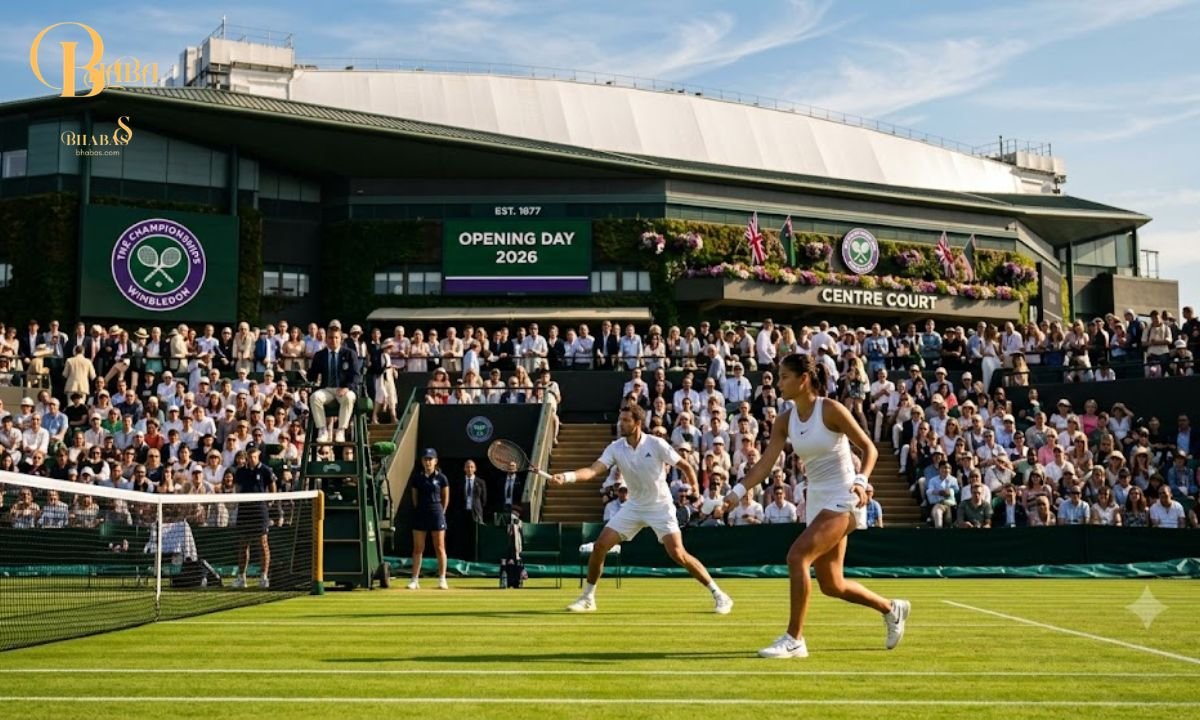
From the hallowed grass of SW19 to the roar of Centre Court — your complete, no-fluff guide to the world’s greatest tennis tournament.
01 · Location
Wimbledon in Which Country? The Home of Grass-Court Royalty
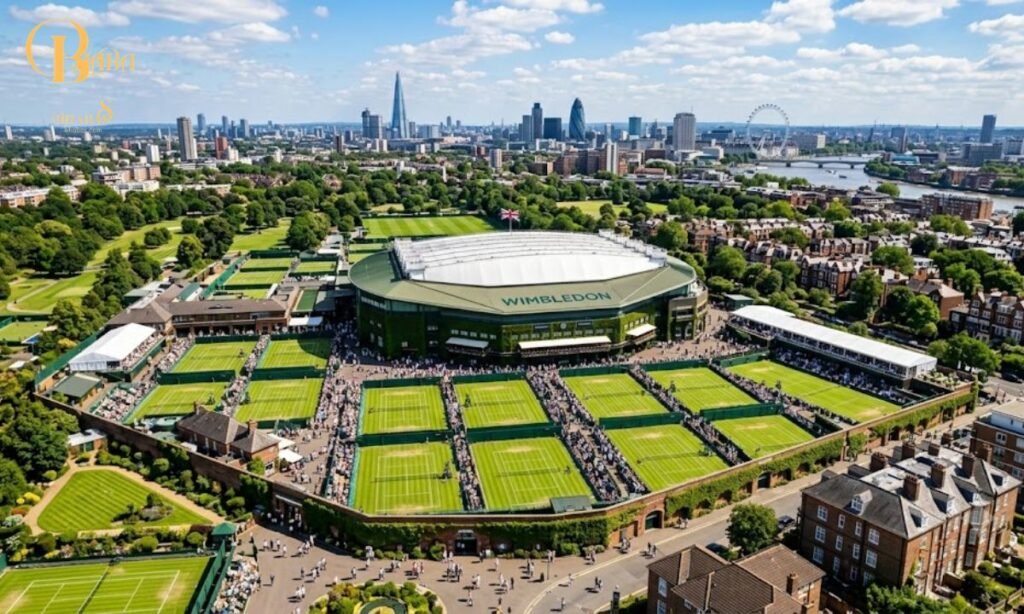
Wimbledon is held in the United Kingdom — more precisely, in the leafy London suburb of Wimbledon, in the London Borough of Merton, South West London, England. It sits roughly 7 miles from the heart of the city, yet feels like a world entirely removed from urban noise.
The full official venue is called The All England Lawn Tennis and Croquet Club (AELTC), a private members’ club that has hosted the Championship since 1877. That’s not a typo — Wimbledon has been played at the same club, on the same sacred stretch of South London real estate, for nearly 150 years.
SW19
London Postcode
18
Show Courts
42
Total Courts
1877
First Championship
To reach Wimbledon from central London, visitors typically take the London Underground’s District Line to Southfields station (about a 10-minute walk to the grounds) or the South Western Railway to Wimbledon station (then a short shuttle bus or 20-minute walk). The route itself has become part of Wimbledon culture — past the queuing fans, the strawberry stalls, and the distant sound of a commentator’s voice drifting over hedgerows.
“Wimbledon is not a place you merely visit. You make a pilgrimage to it — and the journey from London tube to Centre Court feels like crossing into another era entirely.”
02 · History
The History Behind the Most Prestigious Grand Slam on Earth
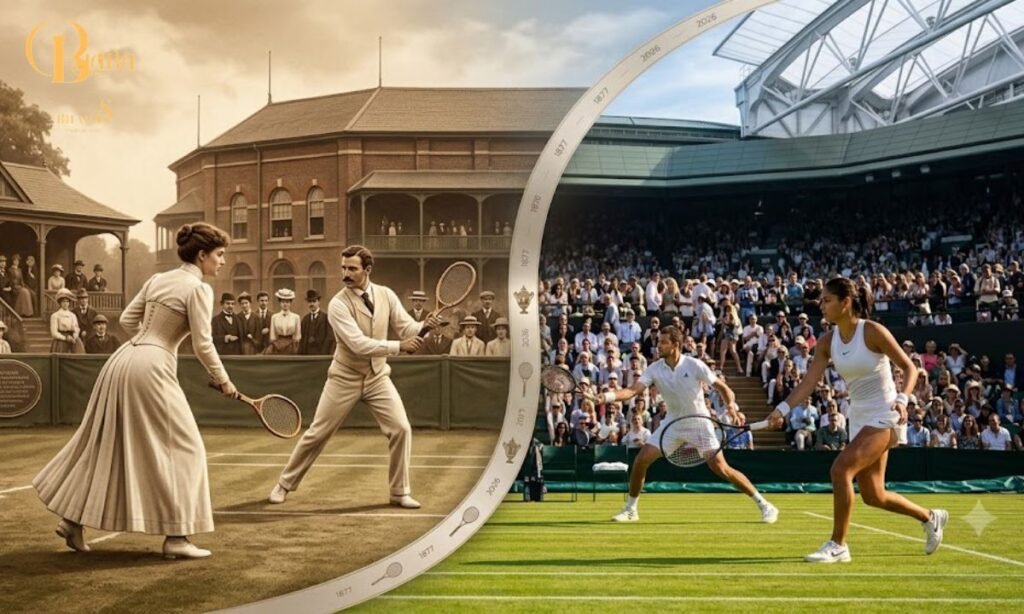
Wimbledon did not begin as a global phenomenon. In 1877, the All England Croquet Club — note, not yet a tennis club — decided to hold a lawn tennis tournament to raise funds for a broken pony roller used on its grounds. Twenty-two amateur gentlemen entered. The winner, Spencer Gore, received a 12-guinea prize. Nobody could have imagined it would one day become the planet’s most-watched annual sporting event after the FIFA World Cup.
Women were admitted to the draw in 1884, just seven years after the inaugural men’s event. The famous Centre Court roof — now a technological marvel capable of closing in under ten minutes — was introduced in 2009, ending decades of rain-soaked abandonments that had frustrated players and fans alike.
1877
First Wimbledon Championship held. Spencer Gore wins the inaugural men’s singles title.
1884
Women’s singles introduced. Maud Watson becomes the first women’s champion.
1922
Championships move from Worple Road to their current Church Road location — the venue as we know it today.
1968
The Open Era begins. Professional players permitted to compete alongside amateurs for the first time.
2009
The retractable roof over Centre Court debuts, eliminating rain delays on the main stage.
2019
A roof is added to No.1 Court, giving Wimbledon a second covered show court.
What has remained constant across all those centuries is the grass. Wimbledon is the only Grand Slam still played on natural grass courts — a surface so demanding and specific that players spend entire off-seasons adapting their game to it. The grass is grown from perennial ryegrass, cut to exactly 8mm before the tournament begins, and maintained by a team of groundskeepers who treat each court like a living artwork.
03 · Players
Wimbledon Players: Stars Who Make the Grass Tremble
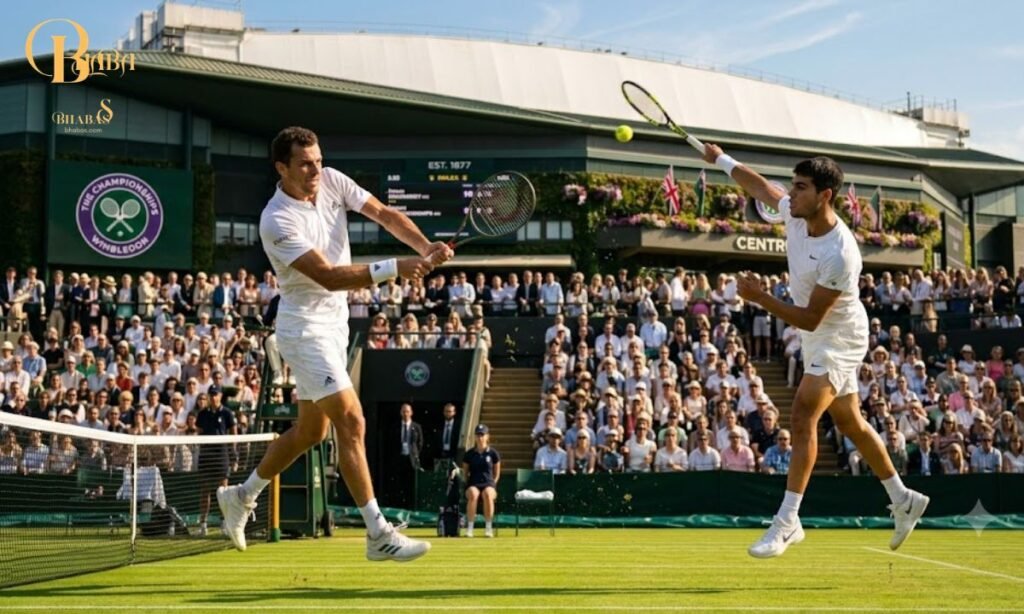
Not every elite tennis player is a Wimbledon player in spirit. The grass court demands a specific athleticism — explosive serve-and-volley instincts, fearless net approaches, and the ability to read a skidding ball in a fraction of a second. The players who thrive at SW19 tend to be those who can mix aggression with touch, pace with patience.
🇷🇸
Novak Djokovic
Serbia · Right-handed
7× Wimbledon Champion
🇬🇧
Andy Murray
Great Britain · Right-handed
2× Wimbledon Champion
🇪🇸
Carlos Alcaraz
Spain · Right-handed
2× Wimbledon Champion
🇮🇹
Jannik Sinner
Italy · Right-handed
World No. 1
🇵🇱
Iga Świątek
Poland · Right-handed
Top Women’s Contender
🇺🇸
Coco Gauff
USA · Right-handed
Rising Grass Court Star
Beyond the headline names, Wimbledon has always been a stage for the unexpected. Qualifiers have toppled seeds. Teenagers have announced themselves to the world. Veteran wildcards have squeezed out one last miracle in the twilight of great careers. That unpredictability — amplified by the volatile bounce of a live grass surface — is what makes watching Wimbledon players feel different from any other event on tour.
04 · The Championship
The Wimbledon Open: What Makes It Unlike Any Other Grand Slam
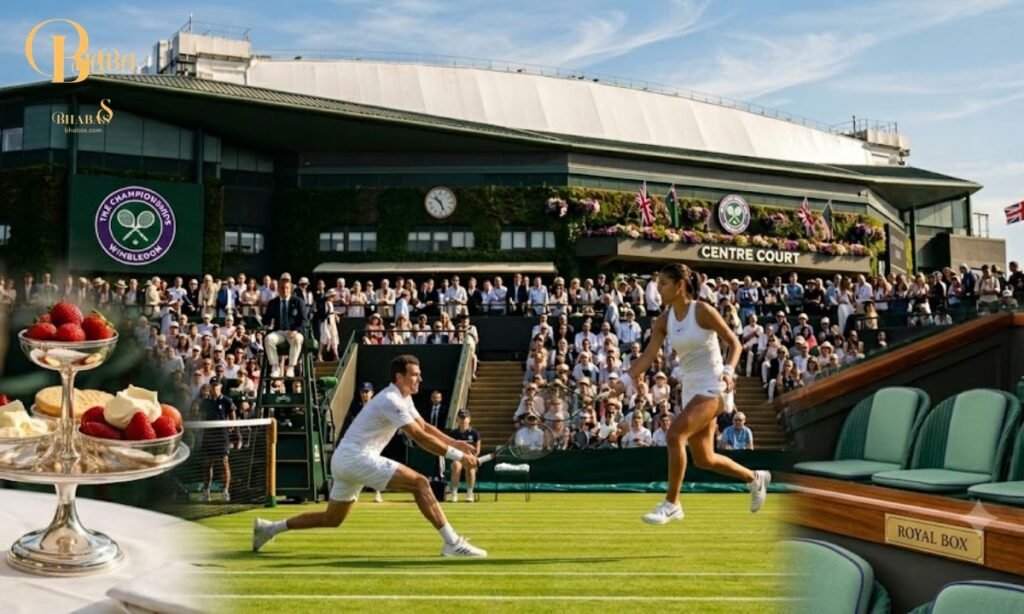
Technically, tennis purists will tell you it’s called “The Championships, Wimbledon” — not the “Wimbledon Open.” Unlike the US Open or Australian Open, Wimbledon has never rebranded itself with corporate modernity. The name is as understated as everything else about it: a quiet confidence that needs no qualifier. The world simply knows.
Wimbledon is one of the four Grand Slam tennis tournaments, alongside the Australian Open (January), Roland-Garros/French Open (May–June), and the US Open (August–September). It holds a singular place among them for several reasons that go beyond sport.
£50M+
Total Prize Money 2025
500,000+
Spectators Per Year
128
Main Draw Players
2 Weeks
Tournament Duration
The dress code is one thing that stands Wimbledon apart. Players are required to wear almost entirely white — a rule that dates back to Victorian sensibilities and remains rigidly enforced today. Even subtle coloring on undergarments has caused friction with tournament officials. It creates a visual coherence unique in professional sport: a sea of white figures moving against the vivid green, watched by 15,000 spectators in the stalls of Centre Court.
Strawberries and cream, Pimm’s in the queue, the sound of ball on gut strings — Wimbledon is simultaneously a sporting contest and a cultural institution, and it manages to be completely sincere about both.
05 · 2026 Tournament
Wimbledon Tennis 2026: Dates, Draw & Who Will Reign on the Grass
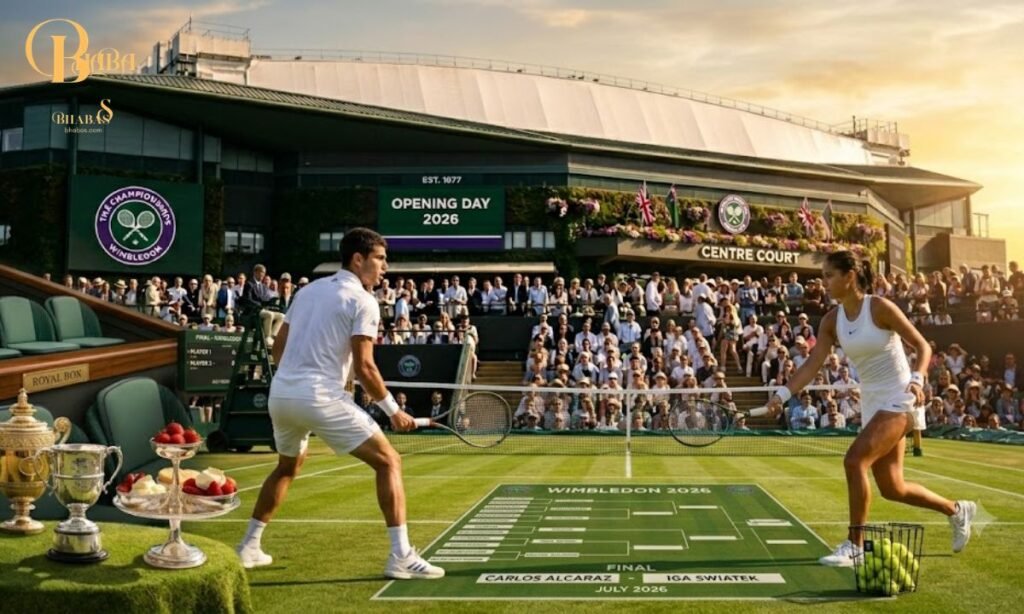
Wimbledon 2026 is set to run from Monday 29 June to Sunday 12 July 2026 at the All England Club in London. That’s two weeks of world-class tennis across 42 courts, from the majesty of Centre Court to the intimate intensity of Court 14, where shocking upsets have ended great careers before the second week even begins.
📅 Key Dates: Wimbledon 2026 runs from 29 June – 12 July 2026. Men’s and Women’s finals are scheduled for the final weekend. The Queue begins as soon as the gates open in late June.
The men’s draw enters 2026 with Carlos Alcaraz as the defending champion following his performances on grass, while Jannik Sinner will be among the most dangerous challengers having consolidated his status as the world’s best player on hardcourt and increasingly on other surfaces. Expect a tournament of enormous quality at the top of the draw.
In the women’s competition, Barbora Krejčíková, who claimed the 2024 title with a performance of remarkable craft and nerve, enters as one to watch alongside Iga Świątek, who has made clear her determination to master the one surface that has historically resisted her dominance, and the electric Aryna Sabalenka, whose serve-first game is built for fast courts.
Wimbledon 2026 will also feature the return of Andy Murray in some capacity — whether as a player or ambassador — given his deep, career-defining relationship with the tournament. Whatever form that return takes, expect Centre Court to give it a standing ovation.
Want to follow the draw live? The official Wimbledon app and wimbledon.com carry live scores, order of play, and player stats updated point by point throughout the fortnight.
06 · Tickets
Wimbledon Tickets: How to Get In Without Losing Your Mind
Getting Wimbledon tickets is notoriously difficult — and that’s half of what makes attending feel so earned. There are several legitimate ways to secure entry, each with its own logic and trade-offs.
| Method | Availability | Best For |
| Public Ballot (AELTC) | Autumn preceding the event | Centre Court, No.1 & No.2 Court |
| The Queue (Day Tickets) | Each morning during the tournament | Show courts + Grounds admission |
| Debenture Holders | 5-year debenture purchase | Guaranteed premium seats |
| Official Resale Portal | During the event | Same-day Centre Court returns |
| Hospitality Packages | Year-round via AELTC partners | Corporate guests, premium dining |
The Public Ballot is the fairest and most popular route for ordinary fans. Applications open in the autumn before each year’s tournament through the official Wimbledon website. Places are allocated at random, and successful applicants can purchase a limited number of tickets for specific days. The ballot for Wimbledon 2026 opened in autumn 2025 and closed in December 2025 — if you missed it, note the dates for 2027.
The Queue is Wimbledon’s famous pilgrimage for day tickets. Fans arrive — sometimes camping overnight — and join an orderly line that snakes through Wimbledon Park. Queue cards are handed out to limit numbers. Those who reach the front receive tickets for Centre Court, No.1 Court, No.2 Court, and grounds passes. It is genuinely one of sport’s most extraordinary social rituals: strangers bonding over bad weather, flasks of tea, and shared anticipation.
💡 Pro Tip: For late-round matches (from the second week), The Queue offers the best chance of getting Centre Court day tickets. Many debenture holders return their tickets, which are resold through the official portal at face value — set an alert on the Wimbledon app.
07 · Legend
Serena Williams at Wimbledon: A Legacy Carved in Grass
If Wimbledon is tennis royalty, Serena Williams is its most decorated queen. Her relationship with SW19 spans more than two decades of astonishing performance — a record that defies easy summary because the numbers alone cannot capture what it felt like to watch her dismantle opponents on that pristine grass.
🏆 2002 Champion🏆 2003 Champion🏆 2009 Champion🏆 2010 Champion🏆 2012 Champion🏆 2015 Champion🏆 2016 Champion
Seven Wimbledon singles titles. A record that places her among the greatest grass-court players in the history of the sport, male or female. But the raw count misses the texture of her Wimbledon career: the final she played in 2018 just weeks after nearly dying from post-partum complications, pushing Angelique Kerber to the limit before conceding in two sets. The 2015 title, where she walked the grounds as the clear favourite and delivered a performance of serene, devastating authority. The emotional farewell years when a body that had endured so much finally had limits the will could no longer override.
Serena won three of her Wimbledon titles without dropping a single set. She won her first title at age 20 and her last at 34 — a span of 14 years at the top of one of the sport’s most demanding surfaces. She partnered with her sister Venus to win the doubles title three times at Wimbledon too, making their combined presence at SW19 a chapter in the tournament’s history that will never be replicated.
When Serena officially retired from professional tennis in 2022, she chose the US Open as her final stage. But it was always Wimbledon where she seemed most entirely herself — powerful, precise, theatrical, and utterly inevitable. The grass at Centre Court holds the echo of her footwork in a way no other surface can.
08 · Culture
Wimbledon Traditions: Why This Tournament Lives in a World of Its Own
No sporting event on earth has a more meticulously preserved culture than Wimbledon. These are not marketing gimmicks — they are practices rooted in decades of genuine habit, and together they form an identity so strong that straying from them would feel like a kind of sacrilege.
Strawberries and cream have been served at Wimbledon since the 1800s. Each year, the tournament gets through approximately 30,000 kilograms of strawberries and 7,000 litres of cream. The berries are grown in Kent, picked in the morning, and served at the grounds the same afternoon.
The all-white dress code for players is perhaps the most discussed rule in tennis. Every item of clothing — shirt, shorts or skirt, socks, shoes, even headbands — must be predominantly white. The rule exists to preserve the aesthetic of the tournament and has occasionally sparked controversy, particularly around women’s undergarments and compression shorts.
The royal box sits at Centre Court and traditionally requires guests to stand when members of the Royal Family enter. In 2003, this convention was relaxed — players are no longer required to bow or curtsey to royals. The box itself holds 74 people and is one of the most closely photographed vantage points in sport.
No advertising on court during play is a rule that creates a visual austerity found nowhere else in professional sport. While Wimbledon is supported by major sponsors, brand logos do not appear on the court surface or nets — Centre Court during a final looks almost exactly as it did in photographs from fifty years ago.
09 · Records
Records & Legends: The Numbers That Define Wimbledon’s Greatest Champions
Wimbledon has been running long enough to generate records so extraordinary they seem fictional. Here are the figures that define its place in sporting history.
9
Martina Navratilova’s Singles Titles
8
Roger Federer’s Men’s Singles Titles
7
Serena Williams’ Singles Titles
7
Djokovic’s Singles Titles
Martina Navratilova’s nine singles titles at Wimbledon between 1978 and 1990 remain the all-time record for any player in the Open Era. Her grass-court dominance during those twelve years was so total that she also claimed seven doubles titles at the same tournament — a combination of singles and doubles success that may never be approached again.
Roger Federer’s eight men’s singles titles came in a run that included five consecutive championships from 2003 to 2007 — a period of such effortless dominance that many tennis writers considered him the perfection of the game on grass. His 2017 title, won at age 35 without dropping a single set throughout the entire fortnight, is widely considered one of the most complete performances in Grand Slam history.
The longest Wimbledon match ever played was the 2010 first-round clash between John Isner and Nicolas Mahut, which lasted 11 hours and 5 minutes across three days. The final set alone ended 70–68 in Isner’s favour. A permanent plaque on Court 18 now marks the occasion — a fitting memorial to two men who gave everything to a grass-court battle the world will never see again.

David is a passionate writer with four years of experience in blessings and prayers blogging. He currently works at Bhabas.com, crafting heartfelt messages that inspire hope, offer comfort, and help people express emotions in a meaningful and lasting way.