
If you have been thinking about getting a Medusa tattoo, you are not alone. This design has grown into one of the most searched tattoo concepts in recent years — and for good reason. The Medusa tattoo meaning goes far beyond a face with snake hair. It carries layers of symbolism rooted in Greek mythology, personal trauma, feminine strength, and spiritual protection. Whether you are drawn to the image for its striking visual power or its emotional depth, this guide covers everything you need to know before making the decision.
From the mythological origins of Medusa to what the tattoo represents for survivors of sexual assault, and from design choices to gendered interpretations — a tattoo artist with years of experience working with clients on meaningful ink breaks it all down here. By the end, you will understand exactly why so many people choose Medusa as their most personal piece of body art.
What Medusa Tattoo Meaning
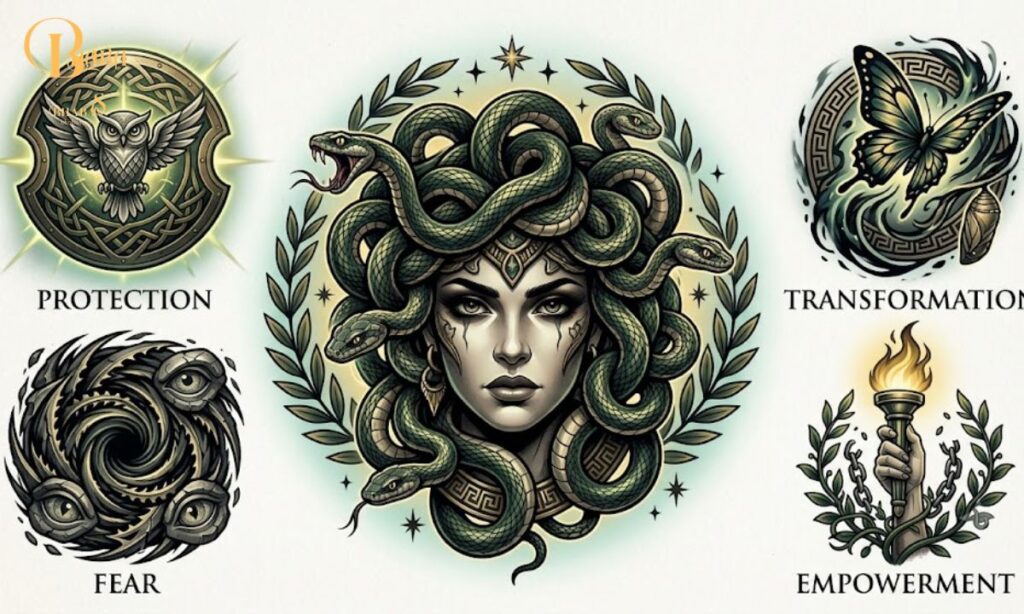
At its core, the Medusa tattoo meaning centers on survival, power, and transformation. The design signals to the world — and to the wearer — that they have faced something painful and come out the other side without being broken. It is a symbol of resilience, protection from harm, and the reclamation of personal identity after suffering.
The meaning shifts slightly depending on the person wearing it, but the most common threads that appear across nearly every interpretation are strength, defiance, and the refusal to be defined by what someone else did to you.
| Core Symbolism | What It Represents |
| Survival | Overcoming trauma, abuse, or hardship |
| Feminine Power | Strength, autonomy, and defiance |
| Protection | Warding off evil, danger, and negative energy |
| Transformation | Personal growth and rebirth after pain |
| Greek Mythology | Connection to ancient stories of power and punishment |
Medusa Tattoo Meaning for Males
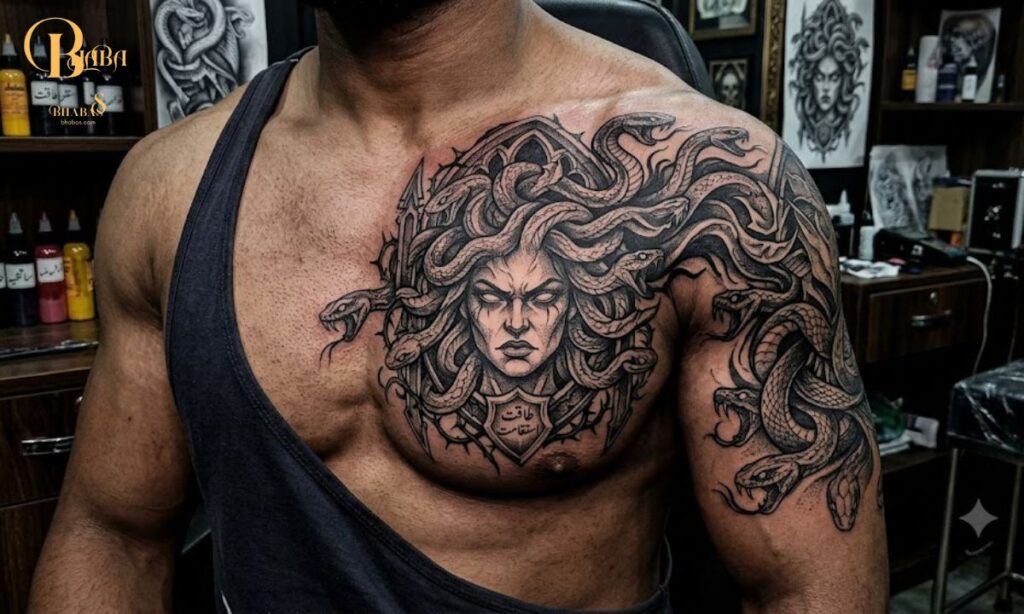
The Medusa tattoo meaning for males is often tied to inner strength, personal resilience, and protection. Men who choose this design may connect with the idea of turning pain into power — of surviving something difficult and refusing to let it define them.
For men who are survivors of sexual assault, the symbol carries the same weight it does for women. Sexual assault affects people of all genders, and the Medusa tattoo offers a way to reclaim the narrative. Beyond trauma, men also choose Medusa to represent their connection to Greek mythology, their appreciation for bold visual art, or their desire to carry a protective talisman. The petrifying gaze of Medusa — turning aggressors to stone — resonates with men who see the design as a symbol of guarding themselves and those they love.
Some men also choose it as a statement against societal norms, as a design that challenges the expectation that powerful mythology belongs only to one gender.
Medusa Tattoo Meaning for Girl

For women and girls, the Medusa tattoo meaning is strongly tied to feminine power, self-definition, and the reclaiming of a story that was long told by others. Medusa has become a central image in feminist discourse — a woman who was punished for being a victim and then reframed as the monster, when in truth she was the one who deserved protection.
For many women, wearing Medusa’s face is a way of saying: I know my own story. It represents the anger women feel when their pain is dismissed or turned against them. The snakes in her hair are often read as controlled rage — power that was born from suffering, not weakness. For survivors in particular, the tattoo is a form of armor and a declaration that they will not be silenced.
Understanding the Medusa Tattoo
Understanding the Medusa tattoo means understanding that it exists in two worlds at once: the ancient world of Greek mythology and the very modern conversation about trauma, identity, and self-expression.
Medusa is one of the most recognizable figures in all of mythology. Her image — a face surrounded by serpents, with eyes capable of turning anyone who meets her gaze into stone — has appeared on ancient shields, coins, and temple carvings. The Greeks used her image as an apotropaic symbol, meaning a symbol used to ward off evil. This protective quality is still one of the primary reasons people choose to ink her image permanently onto their skin.
In modern tattoo culture, Medusa has taken on an additional layer of meaning that reflects contemporary conversations around gender, power, and justice. She has become, for many, a symbol of what happens when a victim is punished for the crime committed against them — and a reminder that such victims can reclaim their power.
The Symbolism of Medusa
The symbolism packed into a single Medusa design is remarkably layered. Here are the three most significant themes:
Feminine Strength & Power
Medusa represents raw feminine energy — the kind that cannot be tamed or ignored. Her image carries the idea that women who have been labeled dangerous, difficult, or threatening are often simply women who refused to be controlled. The tattoo celebrates that energy rather than suppressing it.
In feminist tattoo culture, Medusa’s face is shorthand for a simple truth: the monster was never the villain. She was a woman who was punished, then feared for the power that punishment gave her. Wearing her image is a way of honoring that narrative.
Protective Talisman
In ancient Greece, Medusa’s head was placed on shields, breastplates, and doors precisely because her image was believed to repel harm. This is called a Gorgoneion, and it has been used across cultures for centuries as a ward against evil.
Today, many people get a Medusa tattoo for the same reason — to carry a form of spiritual protection on their body. The placement of the tattoo often reinforces this meaning. A Medusa on the chest sits over the heart. One on the forearm faces outward toward the world. The gaze is always directed away from the wearer — toward whatever might try to harm them.
Transformation & Rebirth
Medusa did not begin as a Gorgon. She was once a mortal woman. Her transformation — however unjust — gave her a kind of power she never had before. Many people who choose this tattoo connect deeply with that idea: something terrible happened, and it changed them, and out of that change came a version of themselves that is harder to break.
This theme of metamorphosis and rebirth makes Medusa a natural companion to other transformation symbols like the phoenix, the lotus flower, and the serpent shedding its skin.
Mythological Origins of Medusa
To fully grasp the Medusa tattoo meaning, you need to know the myth behind the image.
In Greek mythology, Medusa was a mortal woman — strikingly beautiful — who served as a priestess in the temple of Athena. According to the most widely cited version of the myth, she was assaulted by Poseidon, the god of the sea, inside the sacred temple. Rather than directing her anger at Poseidon, Athena punished Medusa by transforming her into a Gorgon: a creature with serpents for hair and a gaze that turned anyone who looked at her directly into stone.
Medusa was eventually killed by the hero Perseus, who used a mirrored shield to avoid her gaze and beheaded her. Even after death, her head retained its power — Perseus used it as a weapon, and Athena later placed it on her own shield.
Key figures in the Medusa myth:
- Medusa — mortal priestess turned Gorgon
- Poseidon — god who assaulted her
- Athena — goddess who punished her
- Perseus — hero who beheaded her
- Pegasus — the winged horse born from Medusa’s blood after her death
What makes the modern reinterpretation of this myth so powerful is the recognition that Medusa was a victim who was punished rather than protected. That injustice is exactly what resonates with so many people who choose to carry her image.
Meaning Behind the Medusa Tattoo
The meaning behind the Medusa tattoo breaks down into several specific, deeply personal categories. Here are the most significant:
SA-Survivor Empowerment
This is perhaps the most significant reason people get a Medusa tattoo today. For survivors of sexual assault, Medusa’s story is a direct mirror: a person who was violated, then punished, then feared for the strength they developed in response. Many survivors see getting this tattoo as an act of reclaiming their own narrative.
As therapist Anita Astley has noted in public discussions around this topic, Medusa represents the journey from pain to resilience — a visual depiction of how survivors transform shame into strength. The act of choosing the design, selecting the placement, and sitting through the session is itself a form of agency over the body.
Bodily Autonomy & Self-Definition
Getting any tattoo is a statement about ownership of your own body. Getting a Medusa tattoo makes that statement loudly and clearly. It says: this body belongs to me, and I choose what it carries.
For people who have had their bodily autonomy violated — through assault, abuse, medical trauma, or controlling relationships — the Medusa tattoo serves as a permanent marker of reclamation. It is a boundary drawn in ink.
Personal Protection Symbolism
Beyond the SA survivor context, many people choose the Medusa tattoo simply because they want to carry a symbol of protection. The ancient Greeks believed her gaze could destroy those who threatened her. That protective energy still resonates with people today who want to feel armored — not against the world, but against the specific people and energies that have tried to diminish them.
The Story of Medusa: A Deeper Dive
The popular image of Medusa as a monster with snake hair often overshadows the complexity of her actual story. In the earliest versions of the Medusa myth — including those predating the most commonly cited Greek accounts — Medusa was not always a monster at all. She was a powerful figure, sometimes associated with wisdom, death, and transformation.
The version of the story that involves Poseidon and Athena is largely attributed to the Roman poet Ovid, writing in Metamorphoses around 8 AD. This later version is the one that has shaped modern interpretations, particularly the reframing of Medusa as a victim.
What strikes many people who study the myth carefully is how much of it is about power and the abuse of it. Poseidon uses his divine status to harm a mortal woman. Athena, instead of directing justice toward the actual offender, punishes the victim. Medusa’s subsequent “monstrosity” is not something she chose — it was imposed on her. And yet from that imposed transformation, she becomes one of the most feared and powerful figures in all of mythology.
That arc — from victimhood to involuntary power to eventual symbolic reclamation — is exactly what gives the Medusa tattoo such lasting resonance.
Emotional and Personal Interpretations
Not every Medusa tattoo carries the same weight. People come to this design from many different places emotionally, and the meaning they assign it is their own.
Some common personal interpretations include:
- “I survived something that was supposed to destroy me.” This is the most common emotional framing. The wearer sees Medusa as a symbol of having come through a difficult experience with power intact.
- “I am not the monster other people made me out to be.” For people who have been labeled or judged unfairly — particularly by family, partners, or institutions — Medusa represents the misunderstood figure who was actually never the villain.
- “I carry this to protect myself.” For people who feel spiritually drawn to protective symbols, Medusa functions as an amulet — a ward against harm worn permanently on the skin.
- “I chose this for myself.” Sometimes the Medusa tattoo meaning is simply about agency. The choice to get it, the design selected, the placement decided — all of it belongs entirely to the wearer.
- “This honors someone I love.” Some people choose a Medusa tattoo in solidarity with a survivor close to them, as a way of saying: I see your story, and I stand with you.
Getting a Medusa Tattoo
If you are seriously considering a Medusa tattoo, there are a few practical things worth knowing before you book your appointment.
Choosing the Right Design
Medusa can be rendered in dozens of styles, and each style shifts the feel and meaning of the design. Here is a breakdown of the most popular options:
| Style | Visual Characteristics | Emotional Tone |
| Realistic | Detailed facial features, lifelike snakes | Intense, emotionally raw |
| Neo-traditional | Bold lines, stylized snakes, flat color fills | Bold, powerful, modern |
| Fine line | Delicate linework, minimal shading | Subtle, intimate, personal |
| Blackwork | Heavy black ink, graphic contrast | Strong, defiant, striking |
| Watercolor | Loose color washes, painterly effect | Emotional, fluid, expressive |
| Traditional | Classic tattoo colors, solid outlines | Timeless, bold, heritage-inspired |
Placement considerations:
- Chest — Over the heart; protective and deeply personal
- Thigh — Large canvas; allows for detailed, full scenes
- Forearm — Visible; faces outward as a protective ward
- Back — Epic scale; powerful statement piece
- Bicep — Classic placement; strength association
- Ribcage — Private placement; personal and intimate
Before finalizing your design, consult with a tattoo artist who has experience with detailed portrait work. Medusa’s face — with its complex expression, serpentine hair, and symbolic gaze — requires a skilled hand to execute well. Look at an artist’s portfolio specifically for portrait realism or mythological work before committing.
Conclusion
The Medusa tattoo meaning is not one-size-fits-all. It is a design that carries centuries of mythological history and a deeply personal modern relevance. For survivors of trauma, it is armor and a declaration of survival. For those drawn to Greek mythology and protective symbolism, it is a talisman with ancient roots. For anyone who has ever been misjudged, labeled, or punished for something done to them — Medusa is a mirror of their experience and a symbol of the power that came from it.
If you are thinking about getting this tattoo, take your time. Understand the story behind the symbol, connect it to your own life, and work with a skilled artist who can bring that meaning to life in ink. A well-executed Medusa tattoo is not just body art — it is a statement about who you are and what you have survived.

David is a passionate writer with four years of experience in blessings and prayers blogging. He currently works at Bhabas.com, crafting heartfelt messages that inspire hope, offer comfort, and help people express emotions in a meaningful and lasting way.