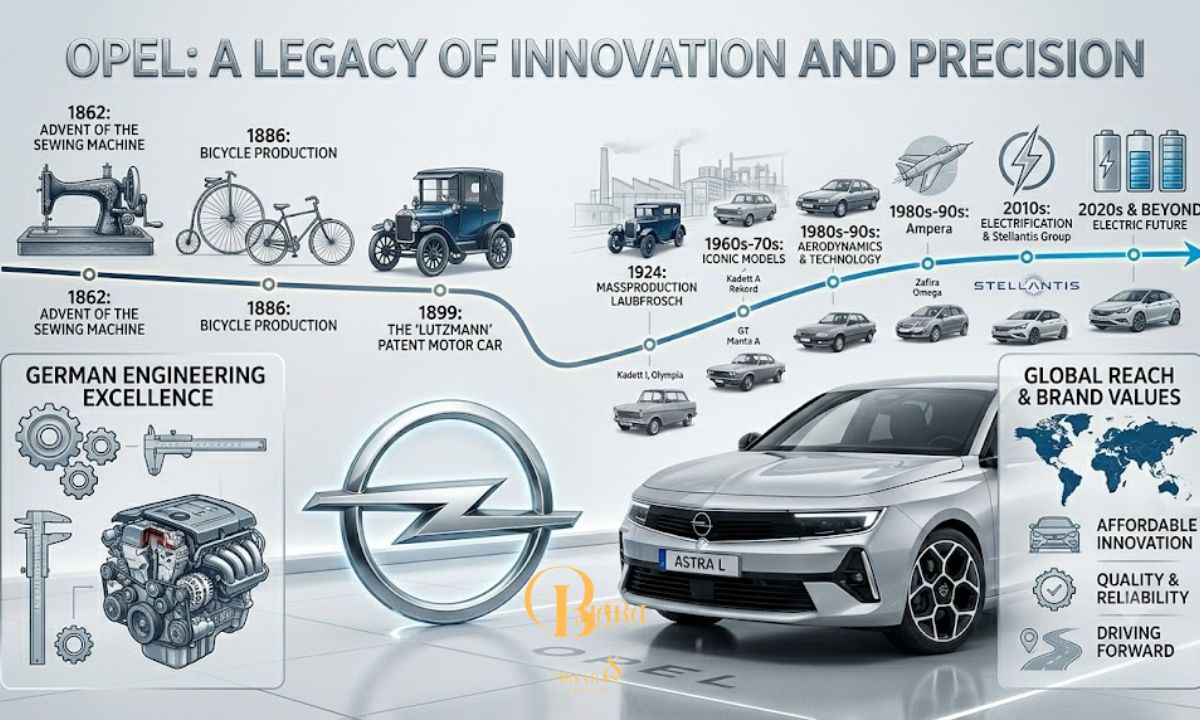
If you’ve come across the name “Opel” and wondered what it actually means, you’re in the right place. Many people search for Opel meaning when they spot the badge on a car or see the brand mentioned in automotive news. The word is not slang, not an acronym, and not a random coinage. It comes from a real person with a real story — rooted in 19th-century Germany and a business that started with sewing machines.
This article covers the complete Opel meaning: its name origin and founder background, brand evolution, logo symbolism, and place in the modern automotive world. Whether you’re researching the brand, studying German car history, or simply curious about what the word stands for, everything you need is here.
Opel Meaning: Simple Definition
Opel Definition
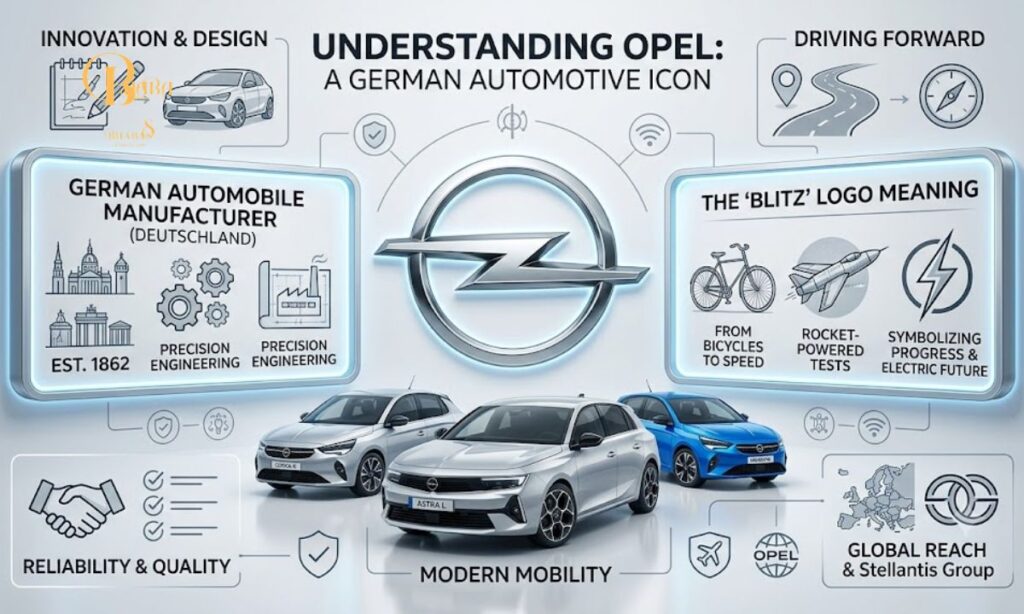
Opel is a German automobile manufacturer. The brand produces passenger cars, SUVs, and electric vehicles sold primarily across Europe. In everyday language, “Opel” functions as a proper noun — a brand name tied directly to its founder’s family surname.
The word itself has no separate meaning in German. It does not translate to another word or phrase. It is simply the name of the man who built the company: Adam Opel.
What Is Opel?
Opel is a mass-market car brand headquartered in Rüsselsheim am Main, Germany. The company was founded in 1862 and has passed through several ownership phases. Today it operates as part of Stellantis, one of the world’s largest automotive groups. Opel vehicles are known for combining German engineering with practical, affordable pricing for European buyers.
Industries Associated With Opel
Opel has not always been an automotive company. Over its 160-year history, it has operated across three industries:
| Industry | Period |
| Sewing machines | 1862 – 1911 |
| Bicycles | 1886 – 1930s |
| Automobiles | 1899 – present |
Origin of the Word “Opel”
Opel Name Origin
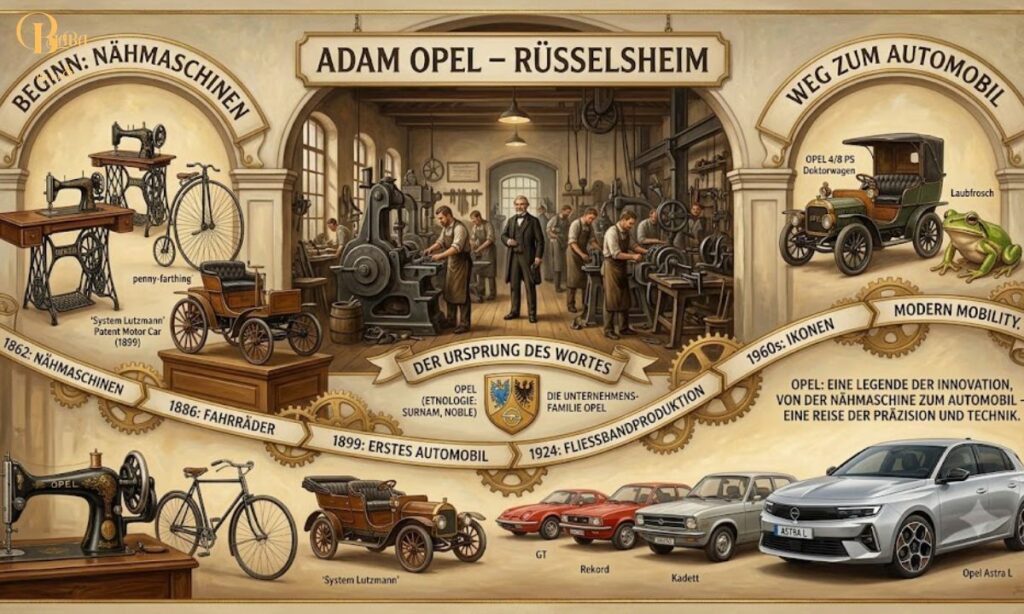
The name Opel comes directly from the surname of the company’s founder, Adam Opel. There is no deeper linguistic meaning behind it. When Adam Opel registered his business, he named it after himself — a common practice among 19th-century European industrialists. Over time, the family name became one of the most recognized automotive brand names in Europe.
Occasionally, the word “Opel” appears on baby name lists with meanings like “jewel” or “precious stone,” but this is an extremely uncommon usage. When most people encounter the word, it refers to the car brand.
Who Founded Opel?
Adam Opel founded the company in Rüsselsheim, Germany, in 1862. He was 25 years old at the time and had just returned from working in Paris, where he had learned about sewing machine manufacturing. His five sons — Carl, Wilhelm, Heinrich, Friedrich, and Ludwig — later took the business into bicycles and eventually automobiles after Adam’s death in 1895.
Early Life of Adam Opel
Adam Opel was born on 9 May 1837 in Rüsselsheim, Germany. His father, Wilhelm, was a locksmith, and Adam trained under him until 20. He then traveled across Europe, working in Belgium before reaching Paris in 1858. There, he encountered the sewing machine and recognized its commercial potential.
In 1859, he took a job with a sewing machine manufacturer to study the technology. In 1862, he returned to Rüsselsheim and set up a small workshop in his uncle’s unused cow stall. That modest beginning became one of Germany’s most important industrial companies.
Is Opel a German Company?
Yes. Opel is a German company. It was founded in Germany, its headquarters remain in Rüsselsheim am Main, and its engineering and design centers continue to operate on German soil.
The confusion around this question comes from the brand’s ownership history. For 88 years, Opel was owned by the American company General Motors. Since 2021, it has been part of Stellantis, a conglomerate with Dutch registration but French-Italian leadership. Despite these ownership shifts, Opel’s identity, design language, and core operations have always remained grounded in Germany.
Opel Ownership History
| Period | Owner |
| 1862 – 1929 | Adam Opel family (independent) |
| 1929 – 1931 | General Motors (majority stake) |
| 1931 – 2017 | General Motors (full ownership) |
| 2017 – 2021 | PSA Group |
| 2021 – present | Stellantis N.V. |
Opel History and Brand Evolution
Founding Era: Sewing Machines
Adam Opel assembled his first sewing machine in Rüsselsheim in August 1862 and sold it to a local tailor. That machine reportedly stayed in use for 40 years. The business grew steadily. By 1868, Opel had built a two-story factory and employed 40 workers. By 1899, the company had produced more than half a million sewing machines. A major factory fire in 1911 effectively ended sewing machine production at Opel for good.
Bicycle Revolution
Adam Opel first encountered a high-wheeled bicycle while traveling in Paris. He was not immediately impressed. But his sons begged for bikes of their own, and he quickly noticed the profit margin was higher than sewing machines. In 1886, Opel produced its first bicycle in Rüsselsheim, making it one of the earliest bicycle manufacturers in Germany.
By 1888, Opel had switched from the penny-farthing to the low-wheel bicycle. By 1890, it had sold 2,200 units. In the 1920s, Opel became the world’s largest bicycle manufacturer. After introducing assembly-line production in 1923, a finished bicycle rolled off the line every seven seconds.
Entry Into Automobile Manufacturing
Adam Opel never lived to see a car bearing his name — he died in September 1895. Four years later, his sons moved into automobiles. In 1898, they purchased the Lutzmann automobile factory in Dessau and began producing cars in partnership with the French company Darracq. By 1902, Opel was building cars entirely on its own, and by 1913 it had become Germany’s largest automobile manufacturer.
Mass Production Breakthrough
In 1924, Opel launched the Laubfrosch — nicknamed the “Tree Frog” — Germany’s first mass-produced automobile. Built on a new assembly line and priced for ordinary workers, it embodied the principle Adam Opel had established from the start: making modern technology affordable for a wide audience. In 1929, General Motors acquired a majority stake, recognizing Opel’s strong European market position. Full GM ownership followed in 1931.
Opel Logo Meaning and Symbolism
What Does the Opel Logo Represent?
The Opel logo is a lightning bolt inside a circle. In German, “Blitz” means lightning. The symbol represents speed, power, and energy — qualities that align with the brand’s automotive identity. The circular frame around the bolt adds a sense of completeness and precision.
The lightning bolt logo is also connected to Opel’s Blitz truck line, which gave the symbol additional brand significance beyond pure aesthetics.
Evolution of the Opel Logo
Opel has used approximately 47 different logo variations since 1862. The major milestones in logo history include:
- 1862–1936: Various wordmark-based designs using the “Opel” name in different typographic styles
- 1937: Introduction of an airship (zeppelin) symbol inside a circle, representing speed and modernity
- 1964: The lightning bolt (Blitz) replaced the airship and became the permanent core symbol
- 2017: PSA Group’s acquisition prompted a cleaner, flatter redesign
- 2020: The most minimalist version of the Blitz launched — thin lines, no 3D effects, ultra-clean yellow-and-black styling
- 2024: A further refined version aligned with the brand’s digital-first and electric vehicle direction
What Does Opel Stand For?
Opel does not stand for an acronym. It is not short for any phrase or set of words. The name stands for the company itself — its history, its German roots, and its founder.
In a broader sense, the Opel meaning within the automotive industry represents accessible, practical European mobility. The brand’s guiding principle, established by Adam Opel and maintained through multiple ownership changes, has consistently been to make technology and innovation available to ordinary people — not just wealthy buyers.
Opel Meaning in the Automotive Industry
In the automotive world, Opel meaning refers to a brand positioned in the mainstream European car segment. It is not a luxury marque. It is not a niche performance brand. Opel competes directly with Volkswagen, Renault, Ford Europe, and Peugeot in the volume segment — cars that balance cost, practicality, and reliability for everyday drivers.
Types of Vehicles Produced by Opel
Opel currently produces vehicles across the following categories:
- Superminis: Corsa
- Compact cars: Astra
- SUVs and crossovers: Mokka, Grandland, Frontera
- Electric vehicles: Corsa Electric, Mokka Electric, Astra Electric
- Vans and light commercial vehicles: Vivaro, Movano, Combo
The brand has committed to offering an electrified version of every model and aims to become a fully electric brand in Europe by 2028.
Famous Opel Models That Built the Brand
Several Opel models have defined eras of European motoring:
- Opel Laubfrosch (1924): Germany’s first mass-produced car
- Opel Kadett: Multiple generations; won European Car of the Year in 1963 and again in 1984
- Opel Corsa: Europe’s longest-running supermini; in continuous production since 1982
- Opel Astra: The successor to the Kadett; won European Car of the Year in 1992
- Opel GT (1968): A two-seat sports car that became a collector’s classic
- Opel Manta (1970): A sporty coupe with a devoted fan following in Europe
Case Study: Opel Corsa
The Opel Corsa is one of the clearest examples of the brand’s core identity. Launched in 1982 as a small, affordable city car, it has run through six generations and remained in continuous production for over four decades.
The Corsa consistently ranks among Europe’s best-selling small cars. It is sold as the Vauxhall Corsa in the UK and has been marketed under different badge names in other markets. Under Stellantis, the current generation is built on the eCMP platform shared with the Peugeot 208. The Corsa Electric version has been a strong seller in the European EV segment.
The Corsa illustrates what Opel meaning has always represented in practice: a dependable, fairly priced car for everyday drivers, updated regularly to include current technology.
Opel vs Other European Car Brands
| Brand | Country | Market Position | Current Parent |
| Opel | Germany | Mainstream | Stellantis |
| Volkswagen | Germany | Mainstream/Premium | Volkswagen Group |
| Renault | France | Mainstream | Independent |
| Peugeot | France | Mainstream | Stellantis |
| Ford (Europe) | USA/Europe | Mainstream | Ford Motor Company |
| Fiat | Italy | Mainstream | Stellantis |
Opel’s closest structural sibling is Peugeot — both brands share platforms and powertrains under Stellantis but maintain separate design identities. Opel leans toward a German engineering identity, while Peugeot emphasizes French style and driving feel.
Opel Pronunciation and Meaning
How to say it: OH-pel (rhymes with “open” without the “n”).
The “O” is a long, open vowel. The “pel” ends cleanly without emphasis. In German, it is pronounced essentially the same way.
Common mistakes:
- “AH-pel” — incorrect vowel
- “O-PELL” — incorrect stress on the second syllable
Is Opel the same as Opal? No. “Opal” is a gemstone. “Opel” is a car brand. They sound similar in English but are entirely different words with different spellings and meanings.
Why People Search “Opel Meaning” Online
Most people search for Opel meaning for one of these reasons:
- They see the badge on a car and do not recognize the brand
- They are comparing European car brands and want background
- They are researching German automotive history
- They wonder if “Opel” translates to something in another language
- They confuse it with “opal” and want to clarify the difference
The search is especially common in markets where Opel is not sold — particularly the United States, where Opel vehicles have not been sold under the Opel name since the 1970s.
Key Facts About Opel
| Fact | Detail |
| Founded | 1862 |
| Founder | Adam Opel |
| Headquarters | Rüsselsheim am Main, Germany |
| Current owner | Stellantis N.V. |
| First product | Sewing machines |
| First automobile | 1899 |
| Logo symbol | Lightning bolt (“Blitz”) |
| EV target | Fully electric in Europe by 2028 |
| UK equivalent brand | Vauxhall |
The Future of Opel
Opel’s future direction is clear: full electrification. Under Stellantis’s “Dare Forward 2030” strategy, Opel has committed to selling only electric vehicles in Europe by 2028. Models like the Corsa Electric, Mokka Electric, and Astra Electric are already in production and performing well across the continent.
The brand also refreshed its visual identity in 2024 with an updated Blitz logo — thinner, more geometric, and designed for digital screens rather than print. The new “Vizor” design language, first seen on the Mokka, gives Opel a cleaner and more modern showroom presence.
Opel continues to engineer and design cars in Rüsselsheim, preserving the German identity that the Opel name has carried for over 160 years, even as corporate ownership has crossed borders.
Conclusion
Opel meaning, at its simplest, is the surname of a 25-year-old German entrepreneur who started a sewing machine business in a borrowed barn in 1862. Over 160 years, that surname became one of Europe’s most recognized automotive brand names — a symbol of practical engineering, accessible pricing, and steady industrial progress.
Understanding Opel meaning also means understanding a broader story: how a single family name came to represent decades of German manufacturing history, multiple industrial pivots, and a brand that has remained relevant through ownership changes, world wars, economic crises, and now a full transition to electric vehicles. The name Opel carries all of that weight simply by being what it is — a family name that became a brand.

David is a passionate writer with four years of experience in blessings and prayers blogging. He currently works at Bhabas.com, crafting heartfelt messages that inspire hope, offer comfort, and help people express emotions in a meaningful and lasting way.