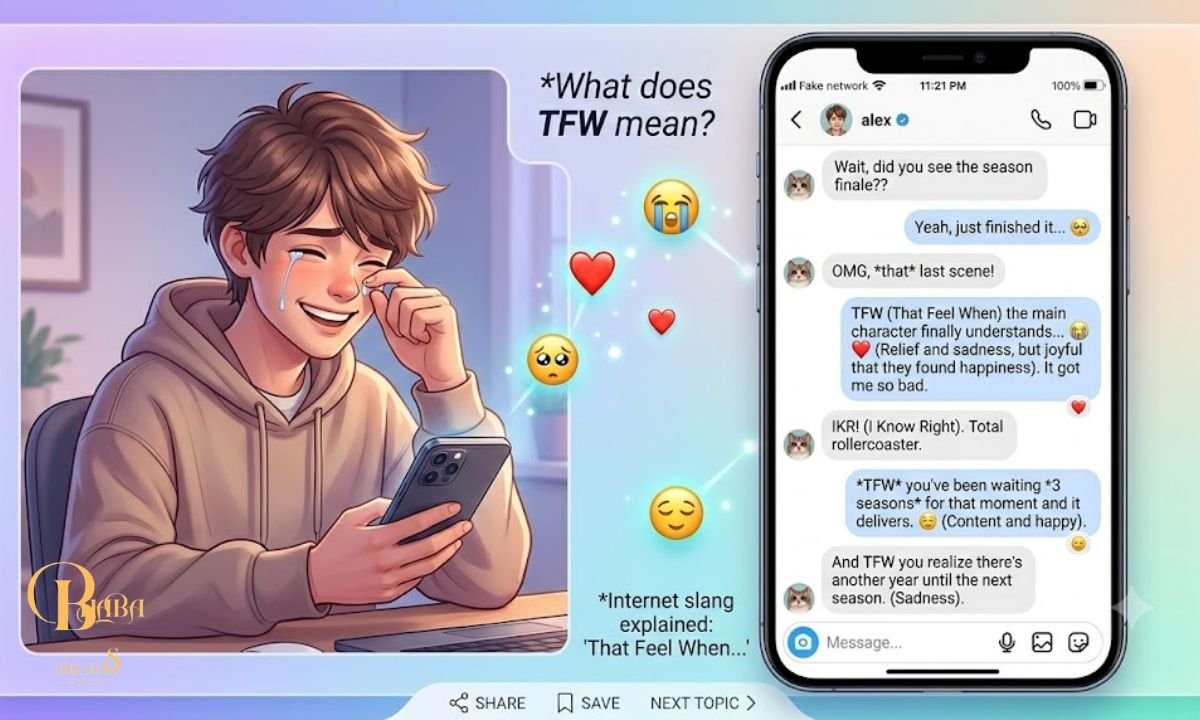
If you have come across the abbreviation TFW while scrolling through social media or texting a friend and had no idea what it meant, you are not alone. Internet slang moves fast, and keeping up with it can feel like a full-time job. TFW meaning is one of the most searched slang terms online, and for good reason. It shows up in memes, Instagram captions, Twitter posts, Reddit threads, and everyday text conversations. Understanding it helps you keep up with how people communicate online in 2026.
TFW stands for “That Feeling When” and is used to describe a relatable emotion or situation in a short, punchy way. Instead of writing a long explanation of how something made you feel, you just type TFW followed by a quick scenario. The reader gets it instantly, especially if they have been in the same situation. This guide covers everything about TFW meaning, its history, usage, and more.
What does TFW mean?
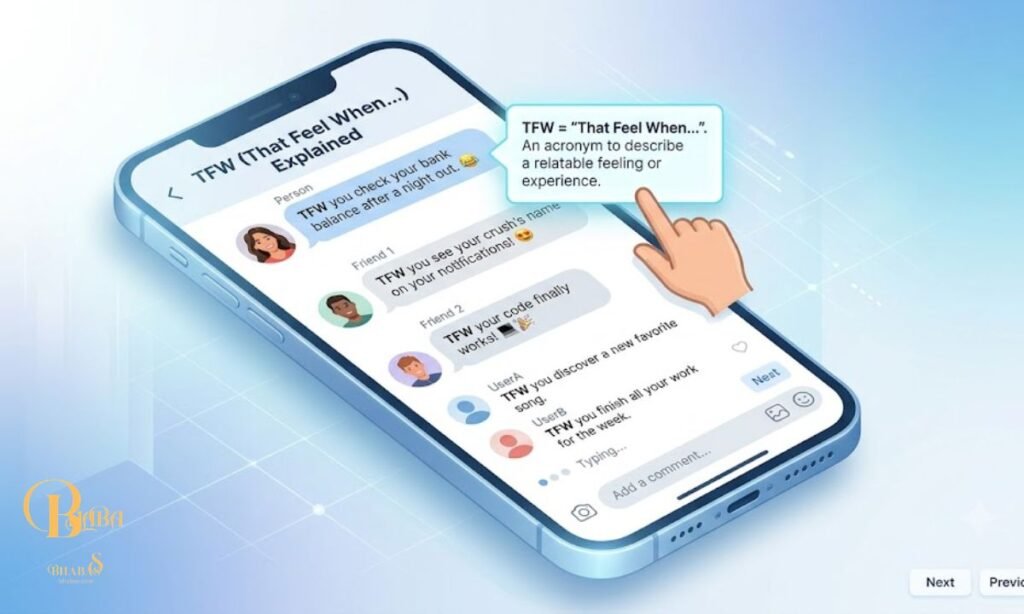
TFW is a three-letter abbreviation that stands for “That Feeling When.” It is also sometimes used to mean “That Feel When” or “That Face When,” though “That Feeling When” is by far the most common version you will encounter today.
The basic purpose of TFW is to set up a relatable emotional situation. You use it at the start of a sentence, followed by a short description of a moment that triggers a specific emotion. The reader is expected to recognize the feeling right away. Here is a simple breakdown:
| Abbreviation | Full Form | Primary Use |
| TFW | That Feeling When | Express relatable emotions |
| TFW | That Feel When | Informal/meme usage |
| TFW | That Face When | Paired with reaction images |
TFW meaning in text is always context-dependent. The emotion it captures can range from joy and excitement to frustration, awkwardness, or even sadness. The phrase works because it invites the reader to step into the writer’s shoes and feel the same thing.
Background & History of TFW
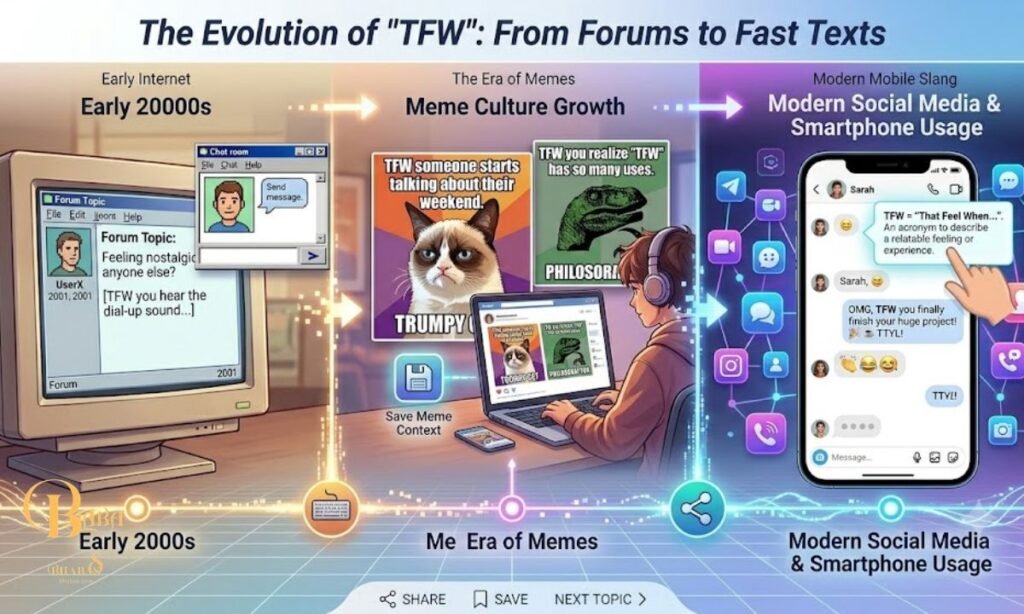
The origin of TFW traces back to early internet culture, specifically to 4chan message boards in the late 2000s and early 2010s. It grew out of a viral meme called “I Know That Feel Bro,” which showed two simply drawn characters embracing in empathy. The image captured the idea of shared emotional experiences, and people began using “that feel when” as a caption format.
As the phrase spread to Twitter, Tumblr, and Facebook, it got shortened to TFW. Meme culture picked it up and turned it into a standard format for relatable content. By the mid-2010s, it had gone mainstream. Google Trends data shows peaks around 2016 when Pepe the Frog memes were at their height, and again around 2020 during the pandemic, when people bonded over shared frustrations.
Today, TFW is a fixed part of internet vocabulary. It appears on TikTok, Instagram Reels, Discord servers, and in everyday messaging. The term has lasted because it taps into something universal: the human need to feel understood.
Usage in Various Contexts
TFW is flexible enough to work across many different situations. Here are the most common ways people use it:
1. Emotional Expression
The most basic use of TFW is to describe a feeling you want others to understand. It works for both positive and negative emotions, though it tends to shine brightest with bittersweet or awkward moments.
• TFW you finally finish a task you have been putting off for weeks.
• TFW you call someone by the wrong name twice in a row.
• TFW you get a surprise compliment from someone you respect.
2. Humor & Memes
TFW is a staple of meme culture. Paired with a funny image or GIF, it turns an ordinary moment into something people want to share. The humor usually comes from the gap between the image and the scenario described.
• TFW you spell-check an email five times and still send it with a typo.
• TFW the vending machine takes your money but does not drop the snack.
3. Relatable Situations
Some of the best TFW posts describe everyday situations that almost everyone has experienced. The relatability factor is what makes people like, share, and comment on these posts.
• TFW your alarm goes off and you realize it is Saturday.
• TFW you plug in a USB device correctly on the first try.
• TFW you find money in the pocket of an old jacket.
4. Social Media Captions
On platforms like Instagram and TikTok, TFW is used as a caption to add context to a photo or video. It makes the post feel personal and invites engagement from followers who relate to the moment.
• A photo of someone holding a finished project: TFW three months of work finally come together.
• A video of someone laughing: TFW your friend tells a story you have heard ten times and it is still funny.
5. Gaming & Online Communities
TFW is very common in gaming communities on platforms like Discord, Reddit, and Twitch. Gamers use it to share frustration, victory, or the pain of in-game moments their community will immediately recognize.
• TFW you lose a match because of a single mistake in the final second.
• TFW you finally unlock a reward you have been grinding for.
TFW Meaning on iPhone
If you have noticed the letters TFW appearing at the top of your iPhone screen where the carrier name usually sits, this is a completely different meaning. In this case, TFW stands for TracFone Wireless, a mobile network operator in the United States.
TracFone Wireless is a Mobile Virtual Network Operator (MVNO), which means it does not own its own tower infrastructure. Instead, it leases network capacity from major carriers, primarily Verizon Wireless, which acquired TracFone in 2021. TracFone operates several sub-brands, including Straight Talk, Simple Mobile, Total by Verizon, Net10 Wireless, and SafeLink Wireless.
You will see TFW on your iPhone’s status bar if you are a TracFone customer or one of its subsidiary brands. It can also appear if your device is roaming on TracFone’s network. This is not an error, just a carrier label. You cannot remove it unless you switch to a different carrier.
Common Misconceptions & Clarifications
Several misunderstandings surround TFW. Here are the three most common ones:
Misconception 1: TFW is a full sentence
TFW is a sentence fragment, not a complete sentence. It lacks a main subject, because “I” is implied. You always follow it with a short scenario. Writing “TFW.” on its own does not communicate anything. It needs context to make sense.
Misconception 2: TFW always means sadness
This is one of the most common misunderstandings. TFW is emotionally neutral on its own. It can express happiness, excitement, embarrassment, confusion, or humor. The emotional tone comes from the situation you describe after it, not from TFW itself.
Misconception 3: It has offensive meaning
TFW does not carry any offensive or harmful meaning on its own. It is a casual expression used to connect people over shared experiences. That said, the content following TFW can be negative or inappropriate depending on what the writer adds. The abbreviation itself is clean.
TFW Meaning in Work
TFW is informal slang, so it generally does not belong in professional communication such as formal emails, business reports, or client presentations. However, some workplaces with casual cultures do use it in internal messaging tools like Slack or Microsoft Teams.
If your team communicates in a relaxed, informal style, TFW can work fine in a group chat. For example:
• TFW the client meeting runs an hour over schedule.
• TFW you finally fix the bug that has been breaking production for two days.
Avoid using TFW in formal written communication, emails to people you do not know well, or any context where professional tone is expected. When in doubt, spell it out as “That feeling when” to avoid confusion.
Similar Terms & Alternatives
TFW belongs to a family of internet slang expressions built around emotional reactions. Here are some closely related terms:
| Term | Stands For | How It Is Used |
| MFW | My Face When | Paired with a reaction image |
| POV | Point of View | Sets up a scenario from your perspective |
| IYKYK | If You Know You Know | Targets a specific audience |
| SMH | Shaking My Head | Expresses disbelief or disappointment |
| TBH | To Be Honest | Introduces a candid opinion |
How to Respond to TFW
When someone sends you a TFW message, how you respond depends on the situation. Here are three common approaches:
1. Agreeing or Relating
If you have had the same experience, say so. Short responses work best because TFW is casual by nature.
• “Literally me every Monday.”
• “Too real.”
• “Same, honestly.”
2. Adding Humor
If the TFW is funny or lighthearted, match the energy with a joke or a funny follow-up.
• “That is my entire personality.”
• “Story of my life.”
3. Continuing the Conversation
If you want to dig deeper, ask a follow-up question to keep things going.
• “Wait, what happened?”
• “Who was it?”
• “Did it work out?”
Regional or Cultural Differences
TFW is primarily used in English-speaking internet communities, particularly in the United States, the United Kingdom, Canada, and Australia. However, it has also spread to non-English-speaking regions through meme culture and social media.
In South Asian countries like India and Pakistan, TFW often mixes with local English slang to create posts that reflect regional experiences. In the Philippines, it is commonly used in Taglish (a mix of Tagalog and English) posts. In Australia, TFW often carries a deadpan or sarcastic tone.
Outside of English-speaking contexts, TFW may not be widely recognized, especially among older generations or those less active on global social media platforms.
Comparison with Similar Terms
TFW is often grouped with MFW (My Face When) and “When you…” memes. Here is how they differ:
| Feature | TFW | MFW | “When you…” |
| Full form | That Feeling When | My Face When | No abbreviation |
| Requires image? | No | Usually yes | Sometimes |
| Emotional focus | Internal feeling | Facial reaction | General situation |
| Formality | Very casual | Very casual | Slightly more readable |
Key difference:
MFW requires a reaction image to make sense because it focuses on facial expression. TFW can stand alone as text and conveys an internal emotion rather than a visual reaction. TFW meaning is broader and more flexible as a result.
TFW Meaning Supernatural
In the Supernatural fandom, TFW takes on a completely different meaning. It stands for “Team Free Will,” the name given to the core group of characters: Sam Winchester, Dean Winchester, and the angel Castiel.
The term originated in Season 5 of the show when Dean sarcastically referred to the trio as Team Free Will during a confrontation with angels who wanted them to follow Heaven’s plan. Fans immediately adopted the nickname, and it became one of the most recognized shorthand terms in the Supernatural community.
After the character Jack Kline was introduced in Season 13, Dean expanded the group and called them “Team Free Will 2.0.” Fans use TFW or TFW 2.0 in fanfiction tags, fan art, social media posts, and discussion threads to refer to this specific group of characters. If you encounter TFW in a Supernatural fan community, this is almost certainly what it means.
Usage in Online Communities & Dating Apps
TFW appears across a wide range of online platforms, each with its own flavor:
• Reddit: Used heavily in meme subreddits and personal story threads to frame relatable moments.
• Discord: Common in gaming servers and friend group chats for quick emotional reactions.
• TikTok: Used as on-screen text at the start of videos to hook viewers with a shared feeling.
• Dating Apps: Profiles on Tinder or Hinge sometimes use TFW to show self-awareness and humor, which signals an easy-going personality.
In group chats, TFW often serves as a bonding tool. Sending it implies that you expect the other person to have had the same experience, which creates a sense of shared understanding without needing a long explanation.
Hidden or Offensive Meanings
TFW itself does not carry any hidden or offensive meaning. It is a neutral setup phrase. However, context matters. In the same way, any sentence can be inappropriate depending on what follows it, TFW can precede content that is sarcastic, crude, or negative.
In rare cases, sarcasm can make a TFW post feel dismissive of serious topics. For example, using TFW to joke about something that genuinely hurt someone close to you would come across as tone-deaf. The abbreviation itself is not the issue. What comes after it determines the tone.
Outside of meme culture, Urban Dictionary lists several alternative interpretations of TFW, including “Travel for Work,” “Tactical Fighter Wing,” and a few user-submitted vulgar definitions. These are not in mainstream use. In everyday chat and on social media, TFW meaning is almost always “That Feeling When.”
TFW Meaning Carrier
As covered earlier, TFW as a carrier name refers to TracFone Wireless. This is entirely separate from the slang term and only relevant if you are a mobile phone user in the United States.
TracFone Wireless is one of the largest MVNOs in the US, with around 21 million subscribers as of recent data. It operates under the Verizon Wireless umbrella after being acquired in 2021. Brands under the TracFone family include Straight Talk, Simple Mobile, Total by Verizon, Net10 Wireless, SafeLink Wireless, and Walmart Family Mobile.
If TFW shows up on your phone’s status bar, it is not a glitch or an error. It simply means your device is connected through TracFone’s network. On newer iPhones with Face ID, the carrier name only appears when you open the Control Center, so you may not notice it all the time.
Suitability for Professional Communication
TFW is not suitable for most professional settings. It is internet slang, and using it in formal communication can make you appear unprofessional or make your message unclear to people who are not familiar with it.
Avoid using TFW in: formal emails, client-facing documents, job applications, official reports, or communication with people you do not know personally.
It may be acceptable in: internal team chats on tools like Slack, casual conversations with colleagues you are close to, or creative/social media-focused workplaces where informal communication is the norm.
If you work in content, marketing, or social media, knowing TFW meaning and how to use it correctly can actually be an asset. It helps you write more natural, relatable content for younger audiences.
Conclusion
TFW meaning most commonly refers to “That Feeling When,” a simple but powerful piece of internet slang that lets people express relatable emotions quickly and without lengthy explanations. It started on early internet boards, spread through meme culture, and is now a standard part of how people communicate online across social media, texting, and digital communities. Whether it is used for humor, emotional connection, or gaming reactions, TFW does one thing well: it turns a personal moment into a shared experience.
Beyond the slang, TFW also appears as TracFone Wireless on iPhone status bars and as “Team Free Will” in the Supernatural fandom. Knowing all these meanings helps you understand the context correctly whenever you encounter it. Use TFW confidently in casual digital conversations, but keep it out of formal or professional writing where clarity and professionalism matter most.

David is a passionate writer with four years of experience in blessings and prayers blogging. He currently works at Bhabas.com, crafting heartfelt messages that inspire hope, offer comfort, and help people express emotions in a meaningful and lasting way.