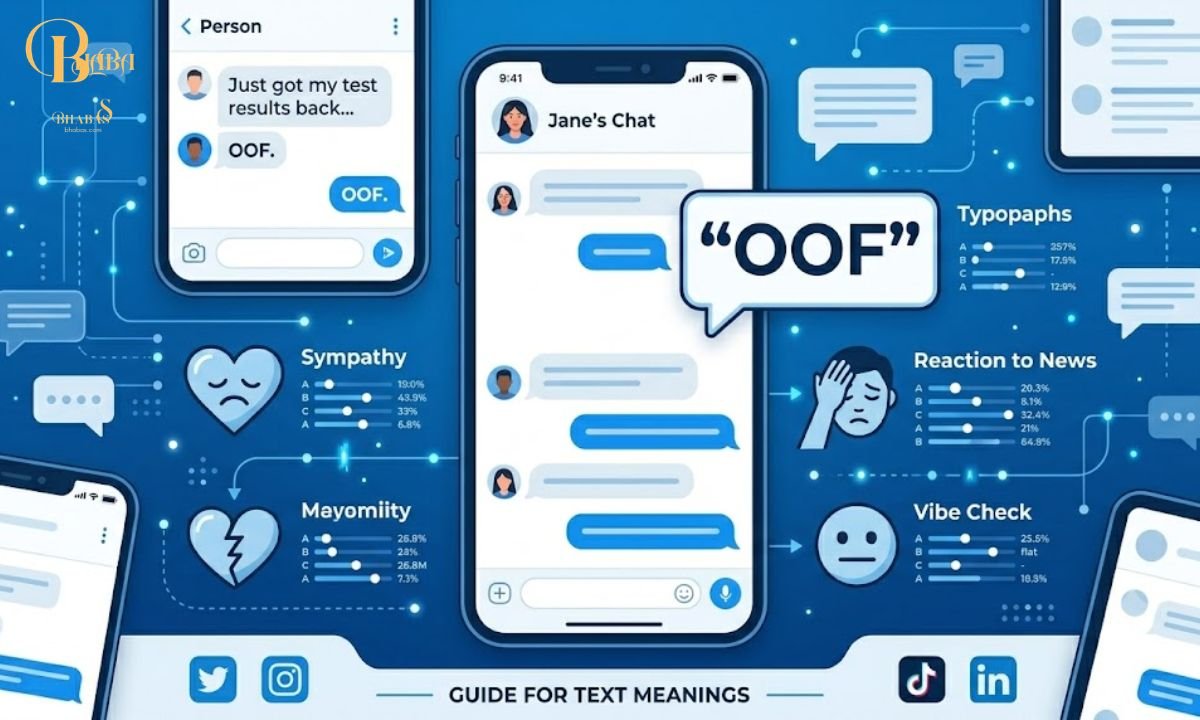
If you have ever seen someone reply “OOF” in a chat and had no idea what it meant, you are not alone. The OOF meaning in text confuses a lot of people because the word shows up in completely different situations casual texts, gaming lobbies, workplace emails, and even dating apps. Understanding it the wrong way can lead to awkward replies or miscommunication. That is exactly why this guide exists: to give you a clear, honest breakdown of what OOF really means and how people use it across different platforms in 2026.
The OOF meaning in text is not always the same. Sometimes it is a pure emotional reaction like saying “ouch” without the drama. Other times, it carries sympathy, humor, or even workplace context. Whether you are a parent trying to decode your teen’s messages, a professional figuring out email shorthand, or someone new to internet slang, this guide covers everything you need to know about OOF in plain, straightforward language.
Definition & Meaning

OOF meaning in text refers to an informal interjection a reaction word people type when something painful, awkward, embarrassing, or unfortunate happens. It is not an acronym in casual use. Instead, it works the same way “ouch” or “yikes” does, but with a softer, more relatable tone.
Quick Definition Table

| Context | What OOF Means |
| Texting / Chat | Reaction to something painful or awkward |
| Gaming | Response to failure, a bad play, or death in-game |
| Email / Workplace | Out of Office (professional shorthand) |
| Social Media | Sympathy, humor, or secondhand embarrassment |
| Dating Apps | Casual empathy or playful acknowledgment |
In short:
- OOF = “ouch / that’s rough / I feel that” in casual conversation
- OOF = Out of Office in professional or workplace settings
The two meanings are completely separate and context is what separates them every single time.
Background & History
The OOF meaning in text has two distinct historical roots, and both are worth knowing.
The Slang Origin Roblox
The casual use of “oof” became a cultural moment thanks to Roblox, a popular online gaming platform. In older versions of Roblox, a short child-like sound effect played whenever a character died or got hurt. That sound was literally “oof.” Players found it funny, relatable, and oddly satisfying so they started typing it out in chats and comment sections as a reaction to any painful or cringe-worthy moment.
From gaming, it spread to meme culture, then to mainstream social media platforms like Twitter, Reddit, and TikTok. By the early 2020s, “oof” was a standard part of everyday internet slang.
The Professional Origin Microsoft
The professional OOF meaning in text has an older backstory. It traces back to Microsoft’s internal email system called Xenix, developed in the late 1980s. Within that system, the auto-reply feature was literally named “oof.” When Microsoft transitioned to Exchange Server, the terminology stuck. That is why, even today, Microsoft Outlook and Teams use OOF as the shorthand for Out of Office auto-replies not OOO (Out of Office), but OOF specifically.
Usage in Various Contexts
Understanding where and how OOF is used makes a big difference in how you interpret it.
In Text Messages
In everyday texting, OOF is a one-word reaction. If a friend tells you they spilled coffee on their laptop, replying “Oof” communicates sympathy and acknowledgment without overcomplicating things.
Example:
Layla: I missed my flight by two minutes. Sara: OOF. Are you okay?
In Gaming
Gamers use OOF constantly to react to bad plays, close calls, team wipes, or losing streaks. It is almost always used with humor rather than genuine distress.
On Social Media
On platforms like Twitter/X, Reddit, and TikTok, OOF appears in comment sections as a reaction to embarrassing posts, relatable failures, or cringe moments. It performs the same social role as “F” (paying respects) but with more personality.
In Slack or Workplace Chats
OOF in casual workplace tools like Slack can mean Out of Office when used as a status, or it can be used informally as a reaction among colleagues in a relaxed team environment.
Common Misconceptions & Clarifications
A few misunderstandings come up frequently around the OOF meaning in text:
- “OOF is an acronym” In casual texting, it is not. It is an onomatopoeic word, not a set of initials.
- “OOF is rude or sarcastic” Not by default. The tone depends entirely on context and any emojis that accompany it.
- “OOF always means Out of Office” Only in professional email or workplace settings. In texting, it almost never means that.
- “OOF is only for Gen Z” Millennials and even older users have adopted the term widely through meme and gaming culture.
Similar Terms & Alternatives
If you want to express the same feeling as OOF, here are common alternatives and how they compare:
| Term | Tone | Best Used When |
| Ouch | Literal, physical | Reacting to pain |
| Yikes | Dramatic, surprised | Something shocking or awkward |
| Bruh | Humorous, disbelief | Absurd or silly situations |
| F | Respectful, meme-like | Paying respects to failure |
| Oof | Neutral to sympathetic | Painful, awkward, or unfortunate moments |
OOF sits in the middle not too dramatic, not too dismissive. That balance is a big part of why it became so widely used.
How to Respond to This Term
When someone sends you “OOF,” they are usually reacting to something you said. Here is how to handle it naturally:
- If it was sympathy: Continue the conversation normally. You could say “Right? It was rough” or “Yeah, not my best day.”
- If it was humor: Match their energy. A laughing emoji or a follow-up joke works well.
- If it felt dismissive: Context matters. If someone only replied “oof” and nothing more, it may just mean they had no other words not that they did not care.
You do not need to over-explain or ask what they meant. In most cases, OOF is a safe, neutral signal that they heard you and acknowledged the moment.
Regional or Cultural Differences
The OOF meaning in text is most widely recognized in English-speaking countries, especially the United States, the UK, Canada, and Australia. However, its reach has expanded through gaming and memes.
- North America: OOF is fully mainstream in text and social media.
- UK / Australia: Recognized and used, though “ouch” or “yikes” may still be more common in some age groups.
- Latin America: Spread mainly through gaming culture, especially Roblox.
- East Asia (Japan, South Korea): Less common in everyday texting; local slang is more dominant.
- South Asia: Growing in use among younger, gaming-oriented communities.
- Professional/Global: In workplace email systems, OOF as Out of Office is understood across multinational companies regardless of region.
Comparison with Similar Terms
Here is a side-by-side breakdown to show exactly where the OOF meaning in text fits among related slang:
| Term | Meaning | Tone | Formality |
| OOF | Reaction to pain/awkwardness | Neutral–sympathetic | Casual |
| OOO | Out of Office (or surprise “oooo”) | Neutral | Professional or casual |
| SMH | Shaking my head | Disappointed | Casual |
| RIP | Rest in peace / “that’s dead” | Humorous or solemn | Casual |
| LOL | Laughing out loud | Humorous | Casual |
OOF is unique because it can carry emotional weight without being negative. It acknowledges a situation without judging it.
What Does OOF Mean in Email
In email, the OOF meaning in text shifts entirely to a professional context. OOF stands for Out of Office and refers to the automated reply that tells senders you are currently unavailable.
Why “OOF” and Not “OOO”?
This is a common question. The reason is Microsoft. The term OOF originated in Microsoft’s Xenix mail system from the 1980s, where the auto-reply feature was named “oof.” That label carried forward into Microsoft Exchange and later Outlook. So when someone at a company says “I’m setting my OOF,” they mean they are turning on their Out of Office auto-reply.
Sample OOF Email Message
Hi, thank you for reaching out. I am currently out of office and will return on [date]. For urgent matters, please contact [colleague name] at [email]. I will respond to your message as soon as I am back.
When to Use OOF in Email
- Going on vacation or personal leave
- Business travel
- Medical leave
- Public holidays
- Remote days with limited availability
Usage in Online Communities & Dating Apps
In online communities Reddit, Discord, gaming forums OOF is a quick reaction that shows you are paying attention and empathizing. It keeps conversation moving without requiring a long response.
On dating apps like Tinder or Bumble, OOF pops up in two main ways:
- Empathy: “OOF, that sounds like a rough week. You okay?”
- Playful acknowledgment: “OOF, you’re out of my league 😄”
It signals that the person is comfortable with casual internet language and is not being overly formal. However, using OOF as your only response repeatedly can come across as low effort pair it with a genuine follow-up for better results.
Hidden or Offensive Meanings
One of the most searched questions around the OOF meaning in text is whether it hides any offensive or inappropriate use.
The straightforward answer: OOF is not offensive. It has no hidden meaning that is rude, sexual, or harmful in standard usage. It is a clean, casual expression that works across age groups.
That said, tone and context can shift any word. If someone types “OOF 😂” after you share something you genuinely found upsetting, it can feel dismissive but that is a social awareness issue, not the word itself. The word does not carry inherent negativity.
There are no known alternate coded meanings for OOF in online slang communities as of 2026.
Suitability for Professional Communication
Should you use OOF in professional settings? Here is the honest breakdown:
When It Is Acceptable
- Casual Slack or Teams chats with close colleagues
- Informal internal messages in relaxed team cultures
- As a status shorthand: “I’m OOF today”
When to Avoid It
- Formal emails to clients or senior stakeholders
- Written reports or official documentation
- First interactions with someone you do not know professionally
Professional Alternatives to OOF
If you want to express empathy or acknowledge something in a professional tone, use:
- “That sounds like a challenging situation.”
- “I understand let me know how I can help.”
- “Noted, and I appreciate you flagging this.”
The OOF meaning in text is best kept to informal channels in a work environment unless your team culture is explicitly casual and you are confident the tone fits.
Conclusion
The OOF meaning in text covers two distinct worlds: casual internet slang and professional email communication. In everyday texting, social media, and gaming, OOF is a versatile reaction word that signals empathy, acknowledgment, or humor in response to something awkward or unfortunate. In workplace email tools like Microsoft Outlook, it stands for Out of Office. Knowing which version applies is as simple as looking at the context.
Now that you fully understand the OOF meaning in text, you can use it confidently or interpret it accurately whenever it shows up in your chats, comment sections, or inbox. Language online moves fast, but some expressions like OOF stick around because they do their job simply and well. Keep this guide handy the next time someone hits you with an unexpected “oof.”

David is a passionate writer with four years of experience in blessings and prayers blogging. He currently works at Bhabas.com, crafting heartfelt messages that inspire hope, offer comfort, and help people express emotions in a meaningful and lasting way.