If you have ever received a message ending with “TTYS” and stopped to wonder what it means, you are far from alone. This four-letter abbreviation pops up constantly in text messages, social media DMs, gaming chats, and even casual workplace conversations — yet many people still pause when they see it. Understanding texting slang like TTYS is not just about keeping up with trends. It helps you read the tone of a conversation correctly, respond appropriately, and avoid unnecessary confusion in both personal and professional settings.
This guide covers everything you need to know about TTYS: its exact definition, its origins, how people use it across different platforms, and when it is (or is not) appropriate. Whether you are a first-time texter, a parent trying to understand what your kids are typing, or simply someone who wants to sharpen their digital communication skills, this article gives you a clear, complete, and practical breakdown of TTYS meaning in text in 2026.
Definition & Meaning
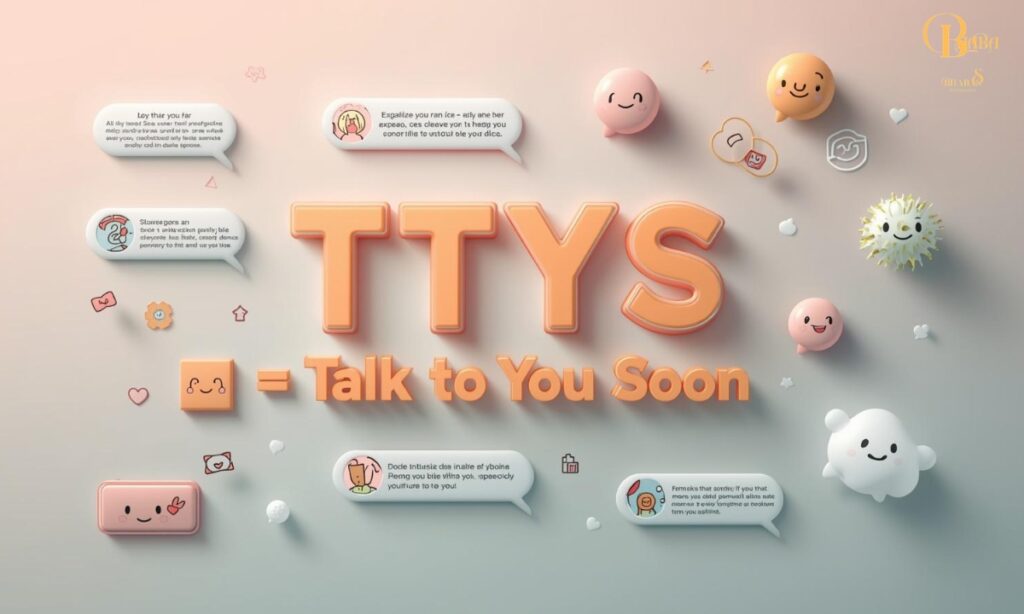
TTYS stands for “Talk To You Soon.” It is a casual, friendly sign-off used at the end of a conversation to let the other person know that communication is not ending permanently — just pausing for a short while.
Think of it as a digital version of “see you soon” or “catch you later.” The key word here is soon, which implies the conversation will pick back up within hours or, at most, a day or two. It carries a warm tone and leaves the conversation on a positive, open note.
Quick Reference Table
| Abbreviation | Full Form | Tone | Time Implied |
| TTYS | Talk To You Soon | Warm, friendly | Short-term (hours to a day) |
| TTYL | Talk To You Later | Casual | Unspecified, open-ended |
| BRB | Be Right Back | Neutral | A few minutes |
| GTG | Got To Go | Neutral/abrupt | Immediate departure |
| CYA | See Ya | Very casual | Unspecified |
Secondary Meanings (Non-Texting Contexts)
Outside of everyday texting, “TTYS” can appear in a few technical or specialized contexts:
- Computing/Unix: TTY refers to a “teletypewriter system” — a terminal interface used in Linux and Unix environments. “TTYS” in this context refers to TTY sessions (plural), and has nothing to do with casual conversation.
- Medical or aviation documentation: May appear as a shorthand notation, though this is rare and context-specific.
When you see TTYS in a chat, text, or social media message, it almost always means “Talk To You Soon.” The technical meanings only apply in clearly technical settings.
Background & History

TTYS came out of the late 1990s and early 2000s, when platforms like AIM, ICQ, and MSN Messenger made real-time chatting mainstream. Slow keypads and SMS character limits pushed people to shorten common phrases — giving birth to abbreviations like LOL, BRB, TTYL, and eventually TTYS.
TTYS developed as a close variation of TTYL. The only difference: “soon” felt more specific and warmer than “later.”
By the mid-2000s, SMS took off globally and these abbreviations moved from desktop chat rooms to mobile phones. TTYS stuck around because it filled a gap — a polite, friendly way to end a conversation without sounding cold or final.
Today it still appears regularly across WhatsApp, Instagram, Snapchat, and Discord. It is less dominant than it once was, but remains widely recognized in 2026 — particularly among millennials and Gen Z who grew up with it.
Usage in Various Contexts
TTYS is versatile. It appears in a wide range of digital communication scenarios, though its appropriateness depends on the setting and the relationship between the people involved.
Casual Texting
This is where TTYS is most at home. Between friends and family, it serves as a natural, low-effort way to close a conversation without sounding abrupt. It implies goodwill and an intention to reconnect.
Examples:
- “Alright, heading out. TTYS!”
- “Gotta pick up the kids. TTYS 😊”
- “That sounds great — let’s finalize the plan. TTYS!”
The tone here is relaxed. There is no obligation or pressure attached. It simply signals that the chat is wrapping up for now, not forever.
Social Media Chats
On platforms like Instagram, WhatsApp, Snapchat, and X (formerly Twitter), TTYS appears in DMs, group chats, and even comment replies. Creators sometimes use it in story captions or at the end of video descriptions to maintain a sense of community connection.
Examples:
- “Thanks for all the support! Going offline for the night. TTYS 🙌”
- “Loved catching up in the comments — TTYS everyone!”
On social media, TTYS carries the same warmth it does in texting. It feels personal without being over-formal, which fits the casual culture of most social platforms.
Online Gaming and Communities
Gaming communities — particularly on Discord, Twitch, and multiplayer platforms — use TTYS regularly. After a gaming session, players often sign off with quick abbreviations rather than long goodbyes. TTYS fits perfectly into this culture.
Examples:
- “Good game, everyone. TTYS for the next session!”
- “Logging off now — TTYS in the Discord server.”
In these spaces, TTYS signals respect and friendliness. It tells other players you are stepping away but plan to return. This matters in communities where regular participation builds relationships over time.
Workplace Communication (Rare)
TTYS does occasionally appear in informal workplace settings, particularly in tools like Slack or Microsoft Teams where casual messaging is common. However, it is far less appropriate in emails, formal reports, or any external-facing communication.
Acceptable example (informal Slack):
- “Done for the day — TTYS about the Q3 update.”
Not appropriate:
- Emails to clients or senior management
- Formal project documentation
- Any written communication where a professional tone is expected
The general rule: use “Speak soon” or “I’ll be in touch” in professional contexts instead of TTYS.
Common Misconceptions & Clarifications
Several myths surround TTYS. Here is a straightforward look at the most common ones and why they are wrong.
Misconception 1: It Means Goodbye Forever
This is probably the most common misunderstanding. Some people interpret TTYS as a final farewell — a sign that the person is cutting off the conversation for good.
The reality: TTYS specifically implies the opposite. The word “soon” is doing important work here. It tells the other person that you intend to reconnect in the near future. It is a temporary pause, not a permanent exit. If someone wanted to say a final goodbye, they would more likely say “bye” or simply stop responding.
Misconception 2: It Is Rude or Dismissive
Because TTYS is short, some people read it as cold or indifferent — as if the sender could not be bothered to write more.
The reality: The brevity of TTYS is intentional and culturally normal in text communication. In the same way that “bye” in person is not considered rude, “TTYS” in a message is simply an efficient, friendly closer. The tone of the conversation before it matters far more than the abbreviation itself. In most cases, TTYS signals warmth, not dismissiveness.
Misconception 3: It Is Rarely Used
Some people assume TTYS is an outdated relic from early internet culture that nobody actually uses anymore.
The reality: TTYS remains a commonly recognized and actively used abbreviation in 2026. While it may not dominate digital conversations the way it once did, searches for “TTYS meaning” have continued to rise, particularly among younger users encountering it for the first time. It appears regularly in texts, DMs, and gaming communities across age groups.
Misconception 4: It Is the Same as TTYL
This is a subtle but important distinction. Many people treat TTYS and TTYL as interchangeable, but they carry different implications.
The reality:
- TTYL (Talk To You Later) is open-ended. “Later” has no specific timeframe — it could mean tomorrow, next week, or whenever.
- TTYS (Talk To You Soon) implies a shorter gap. “Soon” suggests the next conversation will happen within hours or a day or two.
Using TTYS instead of TTYL sends a slightly warmer, more proactive message. It says you are not just leaving — you are actively planning to reconnect.
Similar Terms & Alternatives
If TTYS does not feel like the right fit for a given conversation, several alternatives carry similar or related meanings:
| Term | Meaning | Tone | Best Used |
| TTYL | Talk To You Later | Casual | When timeframe is flexible |
| BRB | Be Right Back | Neutral | Short breaks mid-conversation |
| GTG | Got To Go | Casual/direct | When leaving quickly |
| CYA | See Ya | Very informal | Among close friends |
| TTYT | Talk To You Tomorrow | Friendly | When reconnecting next day |
| TC | Take Care | Warm | As a friendly sign-off |
| LMK | Let Me Know | Collaborative | When expecting a response |
Each of these serves a slightly different conversational purpose. TTYS stands out because it combines warmth with a forward-looking implication — it is not just “goodbye” but “goodbye, and let’s keep this going.”
How to Respond to This Term
When someone ends a message with TTYS, you have a few natural options depending on your relationship and the context.
Common responses include:
- “TTYS! 👋”
- “Sounds good, talk soon!”
- “Sure, catch you later.”
- “Looking forward to it. TTYS!”
- “Take care! TTYS 😊”
The goal is to match the energy of the original message. If someone sends a warm, upbeat “TTYS!”, replying with “k” can feel like a mismatch. Keeping the response light and friendly maintains the positive tone.
What NOT to do:
- Do not overthink it. TTYS is casual — your response can be brief.
- Do not ignore it entirely without a reply if you are in the middle of an active conversation.
- In professional chats, mirror the tone or shift to a more formal sign-off.
Regional or Cultural Differences
TTYS is primarily an English-language internet abbreviation with roots in American digital culture, but it has spread globally alongside English-language platforms like Instagram, WhatsApp, Discord, and TikTok.
A few things worth noting about regional variation:
- North America and UK: TTYS is widely understood and used across generations, though it is more common among millennials and Gen Z.
- Non-English speaking regions: In countries where English is a second language, TTYS may still appear in digital conversations among younger, English-fluent users, particularly in India, Southeast Asia, and parts of Europe. However, local equivalents exist in most languages.
- Generational differences: Older users may be unfamiliar with TTYS or may prefer to write “Talk to you soon” in full. Younger users treat it as completely standard. In some professional environments, even casual users will avoid it in favor of more complete phrases to prevent any ambiguity.
If you are messaging someone outside your age group or cultural context, it is worth defaulting to the full phrase to avoid confusion.
Comparison with Similar Terms
Understanding how TTYS compares to related abbreviations helps you choose the right one for each situation.
TTYS vs. TTYL
| Feature | TTYS | TTYL |
| Full form | Talk To You Soon | Talk To You Later |
| Time implied | Short-term (hours to a day) | Open-ended (could be days) |
| Warmth level | Slightly warmer | Slightly more casual |
| Common usage | Between people planning to reconnect quickly | General goodbye |
TTYS vs. BRB
BRB means “Be Right Back” and is used when someone is stepping away mid-conversation for just a few minutes. TTYS signals the end of a conversation for a longer period. They are not interchangeable.
TTYS vs. GTG
GTG (“Got To Go”) is more abrupt and lacks any forward-looking warmth. It simply says the person is leaving. TTYS is a softer, more intentional goodbye.
Usage in Online Communities & Dating Apps
In online communities and dating apps, TTYS plays a specific social role. It is often used to close out a good conversation while keeping the connection alive — signaling interest without pressure.
In dating app conversations (e.g., Hinge, Bumble, Tinder):
- Ending a chat with TTYS signals that you enjoyed the conversation and want to continue it, without being intense or needy.
- It is a low-pressure way to leave a positive impression.
- Example: “This has been fun. TTYS 😊” reads as warm, confident, and open — a good combination for early-stage connections.
In online communities (Reddit, Discord, gaming forums):
- TTYS helps maintain community culture by keeping departures friendly rather than abrupt.
- Regular members of communities use it to signal that they are stepping away but remain engaged.
- It contributes to the social glue of small, recurring groups like gaming clans or hobby servers.
Hidden or Offensive Meanings
In the vast majority of cases, TTYS carries no hidden, offensive, or inappropriate meaning whatsoever. It is a straightforward, positive sign-off.
However, like most neutral expressions, tone and context can shift its meaning:
- Used sarcastically: In an argument or passive-aggressive exchange, “TTYS” can read as dismissive — a way of shutting down a conversation rather than warmly pausing it. The surrounding context makes this clear.
- Technical misreading: In computing and Unix/Linux forums, “TTYS” refers to terminal sessions. Someone confused about context might mistake a technical discussion for casual slang.
There are no known cases of TTYS carrying a widespread offensive meaning in any cultural or online community context. It is one of the cleaner abbreviations in digital slang. As long as you are aware of the conversational tone leading up to it, TTYS should always read as friendly.
Suitability for Professional Communication
This is one of the most common practical questions people have about TTYS: Can I use it at work?
The short answer is: it depends on the relationship and the platform.
When It Might Be Acceptable at Work
- Messaging a close colleague on Slack or Teams in a casual, ongoing thread
- Wrapping up a friendly internal conversation where the culture is relaxed
- In startups or creative agencies where informal communication is the norm
When You Should Avoid It
- Emails to clients, stakeholders, or senior leadership
- Any formal written communication (proposals, reports, memos)
- First-time or unfamiliar professional contacts
- Industries where formality is the standard (finance, law, healthcare, government)
Better Professional Alternatives
- “Speak soon” — polished and friendly
- “I’ll be in touch” — clear and professional
- “Looking forward to our next conversation” — formal but warm
- “I’ll follow up shortly” — works well in email
The core issue is clarity. Not everyone in a professional setting will know what TTYS means, and using unexplained slang can create unnecessary confusion or appear unprofessional. When in doubt, write it out in full.
What Does TTYS Mean in Text Messages?
TTYS means “Talk To You Soon” in text messages. It is a casual sign-off used at the end of a conversation to let the other person know you plan to reconnect shortly. It is not a permanent goodbye — the word “soon” signals that the chat will continue within hours or a day or two. You will mostly see it in personal texts, WhatsApp messages, and social media DMs between friends, family, or people who talk regularly.
Is TTYS the Same as TTYL?
No, TTYS and TTYL are not the same, although they are often confused. TTYL stands for “Talk To You Later,” which is open-ended and does not specify any particular timeframe. TTYS, on the other hand, stands for “Talk To You Soon,” which implies a shorter gap before the next conversation. If someone uses TTYS, they are suggesting they will be back in touch relatively quickly. TTYL is more of a general goodbye with no implied urgency.
Is TTYS Rude or Dismissive to Use?
TTYS is not rude in most situations. It is generally considered a warm, friendly way to close a conversation. The brevity of the abbreviation is intentional — it is part of texting culture where short forms are the norm, not a sign of disrespect. That said, tone and context matter. If someone uses TTYS during a tense or unresolved conversation, it can come across as abrupt. In a relaxed, positive exchange, it almost always reads as polite and friendly.
Where Is TTYS Commonly Used?
TTYS is most commonly used in personal text messages, WhatsApp and iMessage chats, Instagram and Snapchat DMs, Discord servers, and online gaming communities. It appears less frequently on professional platforms like LinkedIn or in work emails. The abbreviation is most at home in casual, ongoing conversations where both people are comfortable with informal language and texting shorthand.
Can TTYS Be Used in Professional Emails?
It is generally best to avoid TTYS in professional emails or any formal written communication. Not everyone in a workplace setting will be familiar with the abbreviation, and using it can come across as too casual or even unclear. In professional contexts, it is better to write out the full phrase — “Talk to you soon,” “Speak soon,” or “I’ll follow up shortly” — to maintain clarity and a professional tone. In relaxed internal team chats on Slack or Teams, it may occasionally be acceptable depending on workplace culture.
Do People Still Use TTYS in 2026?
Yes, TTYS is still actively used in 2026. While it is not as dominant as it was in the early 2010s, it remains a recognized and commonly understood abbreviation in texting and online chat culture. Search interest in “TTYS meaning” has continued to grow, largely driven by new users encountering it for the first time. It is particularly common among millennials and Gen Z users who grew up with texting shorthand, and it still appears regularly in DMs, group chats, and gaming communities.
Conclusion
TTYS is one of the most straightforward and genuinely useful abbreviations in modern digital communication. It means “Talk To You Soon” — nothing more, nothing less. It is warm, brief, and built for casual conversations where you want to leave on a positive note without sounding overly formal or robotic.
Understanding TTYS means understanding something broader: texting slang is not random noise. Each abbreviation has a purpose, a tone, and a context where it works best. TTYS works best in texts, DMs, social media chats, and gaming communities — anywhere the relationship is friendly and the communication style is relaxed.
The next time someone sends you “TTYS,” you know exactly what it means and how to respond. And now that you understand when, where, and how to use it yourself, you can add it to your own digital vocabulary with confidence — or swap it for a more formal phrase when the situation calls for it.

David is a passionate writer with four years of experience in blessings and prayers blogging. He currently works at Bhabas.com, crafting heartfelt messages that inspire hope, offer comfort, and help people express emotions in a meaningful and lasting way.